What to Check When Trying On a Blazer
A walk through the jacket from collar to hem: what has to be right on the rail, what a tailor can adjust, and how to test it by moving.
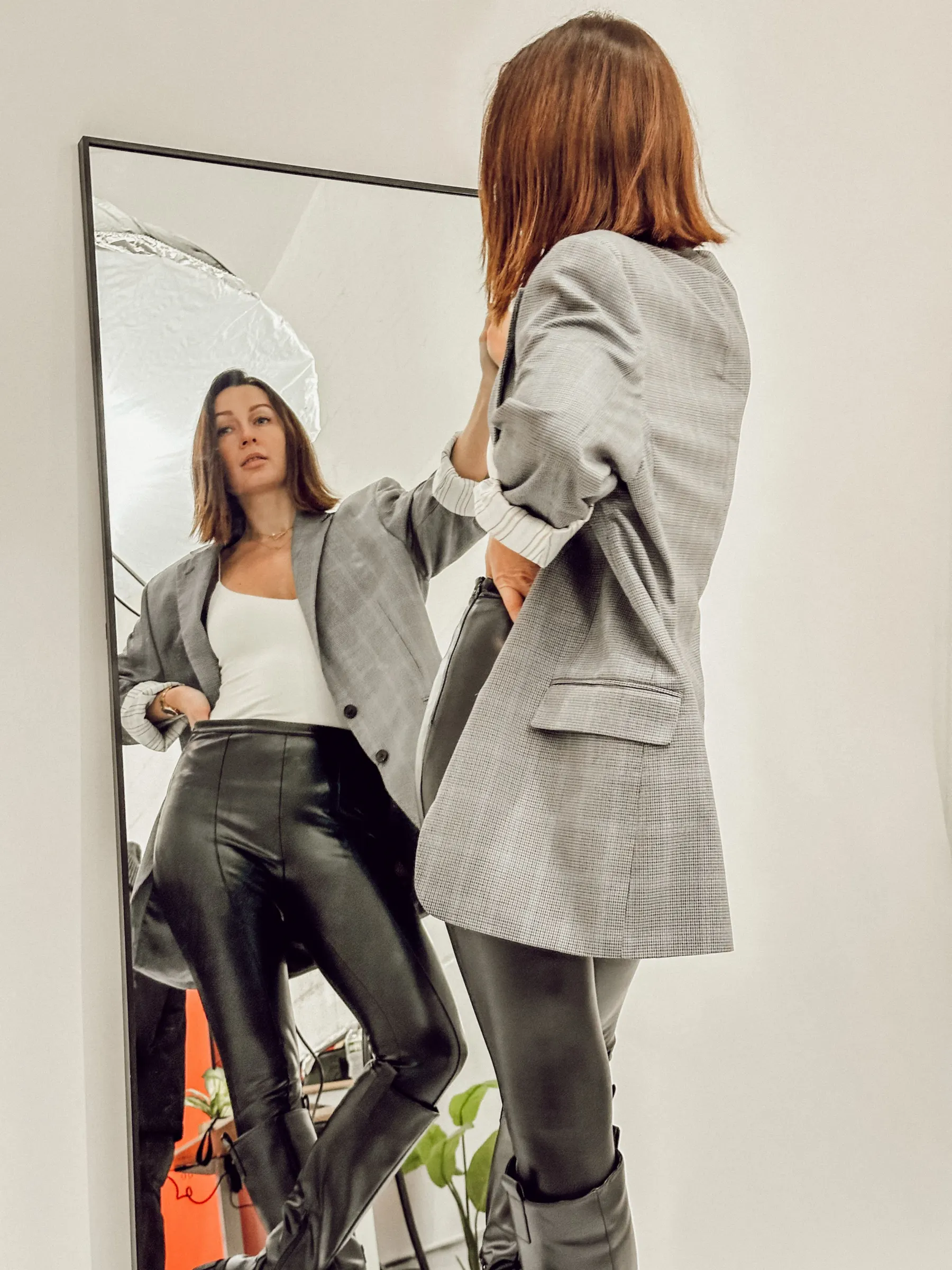
A blazer can be shortened in the sleeve and nipped at the waist, but the area around the neck, shoulders and armholes is close to fixed. That makes the order of checking simple: start at the top, where a problem is hardest to put right, and work down to the parts a tailor can adjust. This walk-through follows the jacket from collar to hem, then asks you to move in it.
It applies whether the jacket is single- or double-breasted, new or second-hand, and whatever side it buttons on.
Wear, or bring, the kind of layer you expect to have underneath. A blazer tried over a thin T-shirt will feel very different over a shirt and a fine jumper (sweater), and the armhole is where you will notice. If you plan to wear it both ways, try both.
Empty your pockets, do the jacket up as intended, and stand as you normally stand rather than pulling yourself up for the mirror. Then look from the top.
Collar and neck
The collar should lie flat and smooth against your shirt collar or the back of your neck; Altering Ready-to-Wear, a University of Minnesota extension bulletin on fitting and altering clothes, puts it simply: collars should lie flat and smooth or stand as designed. Turn side-on to the mirror. If the jacket collar stands away from your neck, leaving a gap you could slide a hand into, or if a roll of cloth bunches just below it, the jacket’s balance does not match your posture.
Take this one seriously. The same bulletin lists the neckline among the areas where garments are most difficult to alter. A collar that sits cleanly when you stand, and returns to its place after you have moved your arms, is a strong sign that the rest of the jacket has a chance.
Shoulders: the part to get right on the rail
On a jacket with a conventional set-in sleeve, the bulletin’s test is that the shoulder seam should rest on top of the shoulder and not draw attention to itself from the front or the back. The seam where sleeve meets shoulder then falls about where your own shoulder ends. Deliberately oversized and dropped-shoulder jackets are cut to sit beyond that point, which is a matter of taste; the checks below still apply.
Look at the cloth between collar and sleeve. It should be smooth. Diagonal wrinkles are worth reading: according to the bulletin, wrinkles running towards the underarm mean the jacket’s shoulder line is too square for you, and wrinkles running towards the shoulder blade or chest mean it is too sloped. Neither says anything about your shoulders being wrong. The jacket was cut on a different slope, and another cut will suit you better.
Shoulder changes are possible but involved. The bulletin describes how shortening a shoulder seam by more than a small amount means removing the entire sleeve and refitting it to the changed armhole. Correcting the slope, it adds, can mean trimming the armhole, and if too much is trimmed away the sleeve feels tight and the arm is difficult to raise. In practice, we would treat the shoulders as something to accept or decline in the fitting room.
Chest, button and back
Fasten the main button. The front should close without the lapels bowing outwards and without creases radiating from the button. If you want to wear the jacket open most of the time, it still helps to know that it can close.
Now the back, which people skip because they cannot see it. Use the second mirror or take a photo over your shoulder. Cloth pulled tight across the shoulder blades when your arms are merely hanging will be worse when you reach. A vent that springs open while you are standing still is worth noticing too: to our eye it reads as a jacket short of room lower down. Loose vertical folds down the back are spare cloth, and spare cloth is the easier direction to correct, as the last section explains.
The chest and underarm appear on the same list of difficult areas as the neckline. So a jacket that is right through the neck, shoulders and chest but a little full at the waist is a far better candidate than the opposite.
Sleeves
Let your arms hang. The sleeve should fall without wrinkles or pulls, the guide says, and be a comfortable length. Where exactly it ends is preference: some like it at the wrist bone so that a little shirt cuff shows; others push sleeves up and never think about it.
If the sleeve feels tight, do not assume the sleeve is the culprit. The bulletin suggests checking whether the back of the garment is too narrow, because a narrow back pulls on the sleeve and makes it feel and look too tight. Bend your elbow fully and bring your hand to your opposite shoulder; you are testing the upper arm and the back together.
If the length is not right, look at the cuff before assuming it is a quick job. Buttons, and especially buttonholes that have actually been cut, sit at a set distance from the edge, so ask an alterations tailor how they would shorten or lengthen that particular sleeve.
Length and where the button sits
Length is a matter of proportion, not correctness. A shorter jacket shows more of the trouser or skirt line and tends to suit high-waisted or wide-legged bottoms; a longer one covers the hip and makes a calmer line over narrow trousers. Try it with the bottoms you actually wear most. If you would like the reasoning behind this, our note on proportion covers it without rules about bodies.
The position of the fastening button matters more than people expect, because it sets where the jacket narrows. Button it and look at where that point falls on you. It is built into the front of the jacket; treat it as fixed.
Move in it
A blazer that only fits while you stand still is a costume. Before deciding, do the things you would really do in it: reach forward as if to a steering wheel or handlebars, lift a bag to a shelf, hug someone, sit down and lean on a table, put your phone in the inside pocket.
Some resistance across the back when you reach is normal in a tailored jacket. What you are looking for is whether the collar lifts off your neck and stays off, whether the whole jacket rides up when one arm rises, and whether the front gapes when you sit.
What is reasonable to hand to a tailor
Two general points from the bulletin are useful when you are weighing up a nearly-right jacket. First, it is easier to take a garment in than to let it out, so check the seam allowances inside if you need more room: turn the jacket inside out, or feel along the centre back and side seams for how much spare cloth is folded there. Second, if a garment is more than one size too large or too small, the bulletin calls alterations impractical, especially around the neckline, shoulders, back and upper chest.
That leaves a sensible list for the tailor: sleeve length, a little shaping through the waist, a button moved or replaced. A good alterations tailor will tell you honestly what is possible, and it is fair to ask before you commit — particularly with a find from a charity shop, where shopping second-hand with a plan includes knowing which faults can be put right and which repairs are worth the effort.
If the jacket passes from collar to hem, the remaining question is whether it has somewhere to go. Picture it with three things you already own; one blazer worn five ways gives a sense of how much a single well-fitting jacket can do.
Sources
- University of Minnesota, Agricultural Extension Service Altering Ready-to-Wear (Extension Bulletin 454), by Lois Goering, 1980