Understanding Proportion Without Rules About Your Body
Proportion belongs to the clothes: where a hem, waistband or jacket edge falls and how big the blocks between them are. Three garments show how it shifts.
Try this before reading further. Put on a shirt or T-shirt and a pair of trousers, leave the top untucked, and take a full-length photo. Tuck the top in, change nothing else, and take another. Look at the two pictures side by side.
The clothes are identical, yet the outfits are not. In the first, the top is a long block and the trousers a shorter one. In the second, the top is a short block and the trousers a long one. That difference, the relative size of the parts of an outfit, is what proportion means in clothes. It belongs to the garments and to where their edges fall. It can be changed in seconds, and no version of it is the correct one.
An outfit is a stack of blocks
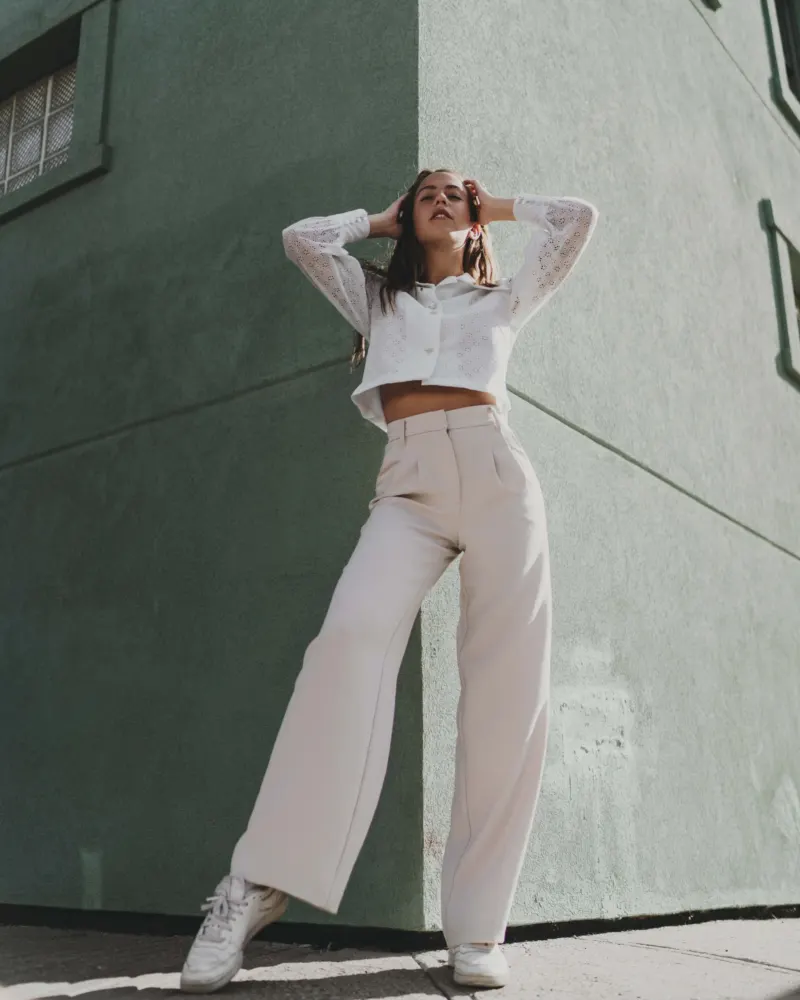
Seen from across a room, an outfit reads as a few blocks of colour and fabric separated by horizontal lines: a hem, a waistband, the bottom edge of a jacket, the top of a boot. Proportion is decided by where those lines sit and how big the blocks between them are.
Two arrangements come up again and again. When the main line falls near the middle, the outfit divides into rough halves, which tends to look even, calm and a little square. When the line falls higher or lower, the outfit divides into something closer to one third and two thirds, which tends to look more directional, because one block clearly leads. Neither is better. Halves suit some garments and moods, thirds suit others, and plenty of good outfits are neither.
The rest of this piece moves three ordinary garments around to show how the lines shift: a shirt, a pair of straight trousers and a jacket.
The shirt: one garment, three hemlines
A shirt has the most adjustable edge in the wardrobe. Worn out, its hem sets the dividing line wherever the shirt happens to end, usually somewhere below the waistband. The top block is long, and the trousers show less of their length.
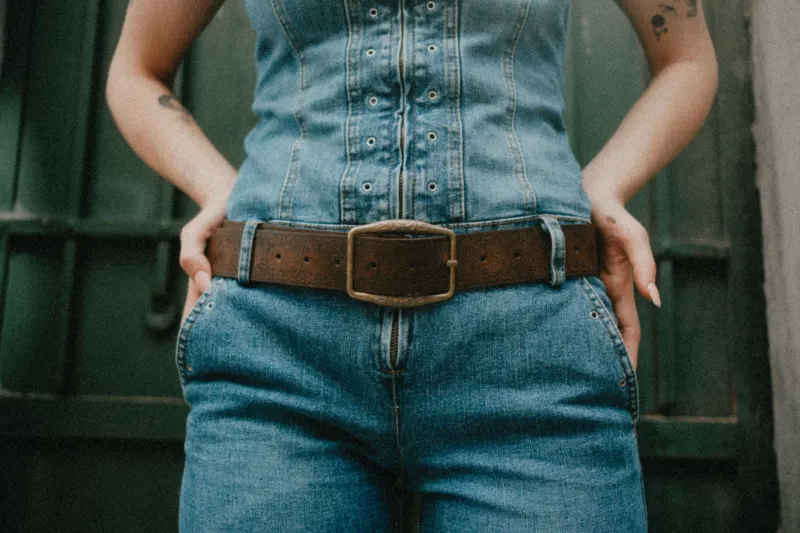
Tucked in fully, the line jumps up to the waistband. The top block shortens, the trouser block lengthens, and the waistband itself, with or without a belt, becomes a visible feature. A belt in a contrasting colour draws that line more firmly, which is the subject of how belts change the proportions of an outfit.
The half-tuck, with the front tucked and the back left out, gives a slanting line: high at the front, low at the back. It shows the waistband without making the outfit look as neat as a full tuck does. Some people like it for exactly that reason; others find it fussy. It is an option, not an improvement.
Sleeves work the same way on a smaller scale. A sleeve rolled to the elbow puts a horizontal line across the middle of the top block and shortens the sleeve’s block of colour; a sleeve worn down keeps one long, unbroken piece.
The trousers: rise and hem
Trousers have two edges that matter here. The top one is the rise, meaning where the waistband sits. A higher waistband makes the trouser block longer and the top block shorter when the top is tucked. A lower one does the reverse. If the top is worn out and covers the waistband, the rise stops affecting the outline at all, and only the top’s hem counts.
The bottom edge is the hem. A full-length hem that reaches the shoe makes trouser and shoe read as one continuous block. A hem that stops above the ankle adds another line, and a strip of sock or skin between trouser and shoe becomes a small block of its own. Turn-ups (cuffs) do something similar by drawing a band at the bottom. How the hem and the shoe meet is covered in detail in matching shoes to trouser shapes.
Width changes the block’s character without moving its edges. A wide leg makes the lower block broad and gives it movement; a narrow leg makes it a narrow column. The same top will look larger next to a narrow trouser and smaller next to a wide one, simply by comparison.
The jacket: a second hemline
Adding a jacket adds a line, and that line often takes over from the one underneath. Three lengths show the range.
| Jacket length | Where its hem falls | What it does to the outfit |
|---|---|---|
| Cropped | At or just above the waistband | Short top block, long lower block; shows the waistband and the full line of the trousers or skirt |
| Hip length | Below the waistband, around the trouser pockets | Closer to even blocks; covers the waistband, so a tuck or belt underneath matters less |
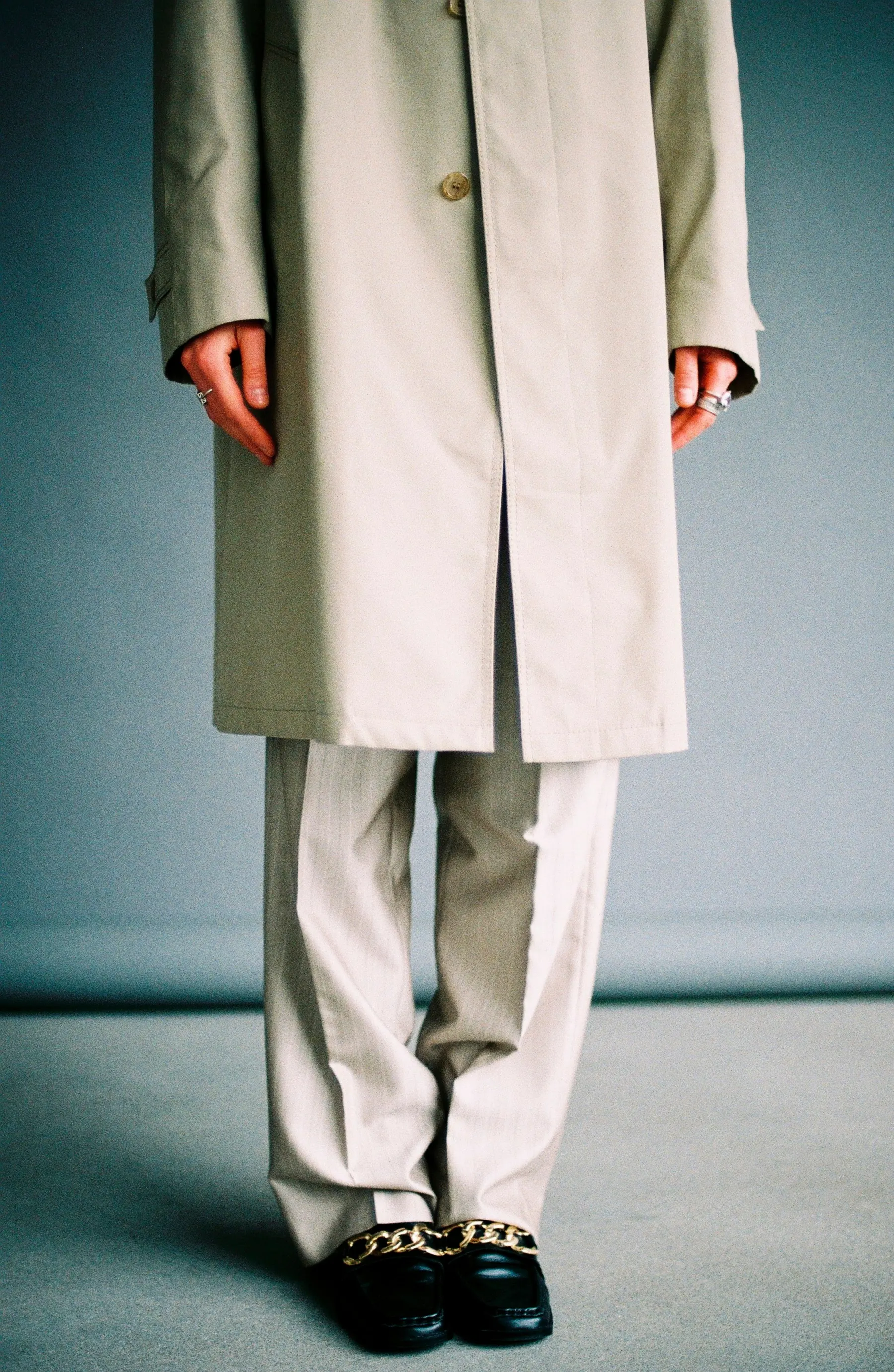
| Long | Mid-thigh to knee or below | The coat becomes the main block; what is under it shows as a strip at the front and a shorter block below |
Whether a jacket is worn open or closed matters almost as much as its length. Closed, it is one solid block with a clear bottom edge. Open, it becomes two vertical panels framing whatever is underneath, and the eye reads the inner column of shirt and trousers as well as the outer shape. An open long coat over a single colour gives a strong vertical stripe down the middle of the outfit; the same coat buttoned gives one large shape.
Volume: loose with close, loose with loose
Blocks have width as well as height. A common starting point is one loose piece with one close-fitting piece: a roomy jumper with narrow trousers, or a fitted top with wide trousers. The contrast makes each shape easy to read, and the article on wide-leg trousers works through several versions.
That pairing is a convention, though, not a law. Loose with loose, such as an oversized shirt over wide trousers, gives a single generous shape, and it usually helps to show where one piece ends, with a tuck, a shorter top or a clear change of colour. Close with close gives a narrow, continuous outline in which fabric and colour do more of the talking. Each sends a different message; all three are legitimate.
One set of clothes, two proportions
A demonstration, not a prescription: the same pieces arranged as thirds and then as halves.
- Pieces
- A white shirt, navy straight-leg trousers, a grey hip-length blazer, brown loafers. First version: shirt tucked, blazer open, so the line sits at the waistband. Second version: shirt out, blazer buttoned, so the line sits at the blazer hem.
- Swaps
- A T-shirt for the shirt, a chore jacket or cardigan for the blazer, a straight skirt for the trousers. The experiment works with any top, bottom and outer layer.
- The detail
- The few centimetres of shirt showing below the buttoned blazer in the second version. They add a pale band that makes the top block look longer still; tucking only the front removes it.
A fifteen-minute experiment with your own clothes
Choose one outfit you wear often and photograph it full length, in the same spot, in four states: top out; top tucked; with an outer layer open; with the outer layer closed. If the trousers allow it, add a fifth with the hems turned up once. Keeping the camera position fixed is what makes the pictures comparable, and taking useful outfit photos explains how to set that up.
Look at the photos small, as thumbnails, so that detail disappears and only the blocks remain. Ask which version you would reach for on an ordinary day and which for an occasion, and try to say why in terms of the garments: “I like more trouser showing”, “I prefer the coat as the main shape”. Those sentences are your own proportion preferences, and they will transfer to other clothes far more reliably than any rule written for somebody else.