A Small Accessories Collection with Plenty of Options
An inventory of belts, scarves, bags and jewellery sorted by the job each does, an example set of twelve pieces, and one outfit worn three ways.
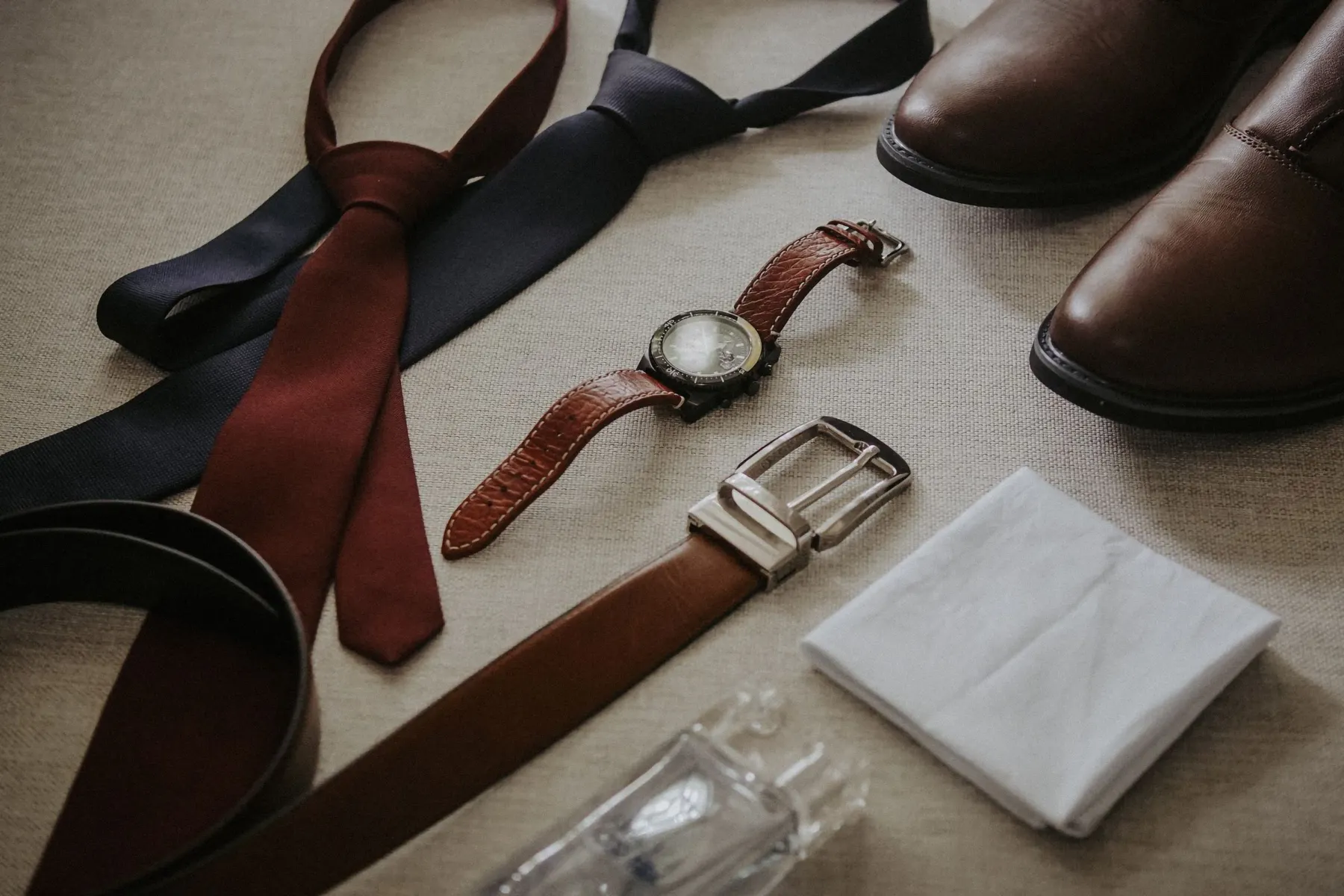
Accessories tend to arrive one at a time, each bought or given for a single outfit or occasion, and then settle into drawers where they are forgotten. The result is often a large number of things and a small number in use. An inventory, done once on a bed or a table, shows which is which, and usually shows that a dozen well-chosen pieces are doing nearly all the work.
Lay it all out and count by job
Gather everything that is not a garment and not a shoe: belts, scarves, hats, gloves, bags, jewellery, watches, ties, sunglasses, hair accessories. Group them not by type but by what they do.
- Things that hold or carry: belts, bags, braces (suspenders), a watch strap.
- Things that keep weather out: winter scarves, gloves, hats, sunglasses, an umbrella.
- Things that add colour or pattern: printed scarves, ties, pocket squares, a bright bag.
- Things that add a point of light or detail: jewellery, a watch, a buckle, a brooch.
Some pieces sit in two groups, and those are worth noticing. A rust wool scarf keeps you warm and is also the only colour in a navy-and-grey winter outfit. A tan belt holds up trousers and repeats the colour of your shoes. Pieces with two jobs are the backbone of a small collection.
Mark what you wore this month
Move to one side everything you have worn in the past four weeks, allowing for the time of year. This pile is nearly always smaller than expected, and it tells you what you reach for: perhaps one watch, the same small earrings, one belt, the scarf by the door.
Look at what the worn pieces have in common. They are usually comfortable, easy to put on with one hand, and agreeable with most of your clothes. Then look at the unworn pile and ask of each piece why it stayed behind. Uncomfortable, fiddly, the wrong colour for your current clothes, in need of repair, or waiting for an occasion that comes once a year? Each answer points somewhere different: a repair, a different way of wearing it, a place in a keepsake box, or a new home with someone else. The approach is the same as in our practical wardrobe audit, where nothing has to be thrown out to learn something from the sorting.
What a small working collection can look like
There is no ideal list, because wardrobes and climates differ. As an illustration, here is a collection of twelve pieces built for a wardrobe of mostly navy, grey, white and denim, with brown leather shoes and white trainers (sneakers).
- A tan or mid-brown leather belt, about 3 cm wide.
- A second belt in black, or a woven fabric one for summer.
- An everyday bag sized to what you carry.
- A smaller bag, or a tote, for the days the first one does not suit.
- A warm scarf in a colour your coat does not have.
- A light scarf or bandana in a print that includes one of your main colours.
- A knitted hat, and for sun a cap or a brimmed hat.
- Gloves in leather or wool.
- Sunglasses.
- A watch, or a bracelet worn in its place.
- One piece of jewellery worn daily: small earrings, a fine chain, a ring.
- One larger piece for when you want it to be noticed: a bold necklace, a brooch, a patterned tie, statement earrings.
Someone who wears a suit to work would swap in three or four ties and a pocket square. Someone who wears no jewellery would give those places to another scarf or hat. The principle is one piece per job, a second where your life really has two versions of that job, and a small number of pieces kept purely because you love them.
One outfit, three sets of accessories
The reason a small collection goes a long way is that accessories multiply against clothes rather than adding to them. Take a single plain outfit and change only what surrounds it.
Grey jumper and dark jeans, three ways
A grey crew-neck jumper (sweater), dark indigo jeans and brown leather boots, worn on three different days with nothing changed but the accessories.
- Pieces
- Quiet: brown belt, watch, nothing else. Warm and colourful: the rust scarf wrapped once, knitted hat, the everyday bag across the body. For the evening: the larger necklace or a brooch on the jumper, the small bag, belt changed to black with black boots.
- Swaps
- A printed bandana at the neck in place of the necklace. A shirt collar showing above the jumper with a tie for a smarter daytime version. In summer, the same exercise with a white T-shirt: sunglasses, a woven belt and a canvas tote do the work.
- The detail
- One point of interest at a time. With the scarf, the jewellery stays minimal; with the necklace, the neck stays clear. The outfit changes character because the emphasis moves, not because more is added.
If you would like to push this further, a scarf is the most versatile single item in the list, and how to use a scarf without overcomplicating an outfit covers three ways of wearing one. The bag is the piece most worth choosing carefully, starting from what you actually carry.
Duplicates and real gaps
The inventory tends to reveal clusters. Five black belts of nearly the same width; seven scarves, six of them in shades of grey; four pairs of sunglasses. Duplicates are not a fault. They are information about your taste, and the best of each cluster can go into daily use while the rest wait as spares.
Real gaps are rarer and more specific than they feel. A gap is a job with nothing to do it: no belt that fits the loops of your favourite trousers, no gloves you can use a phone in, nothing warm that is not black. Colour is a common one. In a wardrobe of neutrals, the accessories are the smallest commitment and so the easiest place to keep the colour, a point made at more length in our piece on adding colour to a mostly neutral wardrobe. If a gap survives a month of noticing it, write it down precisely; if you forget about it, it was not a gap.
Keep them where you can see them
Accessories go unworn mostly because they are out of sight at the moment of getting dressed. A few hooks inside the wardrobe door for belts and necklaces, a shallow tray for the watch and daily jewellery, scarves rolled upright in a drawer so that every one shows its edge: none of this requires special equipment. The test of the arrangement is whether you can see every piece in the working collection without moving another.
Keep the pieces you love but rarely wear in a separate box, and open it when the season or the occasion changes. Brought back out after a few months, a forgotten brooch or a silk square often feels like something new.