A Practical Wardrobe Audit Without Throwing Everything Away
One category at a time, four piles, and no bin bag: a slower way to sort your clothes that asks what each piece needs in order to be worn.

Four o’clock on a Sunday. Every garment you own is on the bed, the wardrobe is empty, the light is going, and you have just found a third pair of black trousers you had forgotten about. In about an hour you will need somewhere to sleep. This is the moment when things get stuffed into bin bags, and when a perfectly good coat goes to the charity shop because you were tired.
An audit does not have to work like that. The version below is slower, takes less space, and has no pile called “get rid of”. Its purpose is to find out what each garment needs in order to be worn — and to be honest about the few that will not be.
Take one category, not the whole wardrobe
Choose a single group that fits on a chair: all the trousers, or all the knitwear, or every shirt. Forty minutes is a realistic length for one session. Doing knitwear this week and trousers next week means the room stays usable and your judgement stays fresh; decisions made in the third hour of a full clear-out are rarely the ones you would make rested.
Seeing a whole category side by side also shows things a rail conceals. Three grey crew-necks are not a problem in themselves, but it is worth noticing which one you always pick and what it has that the other two lack — a neckline that sits closer, a length that works untucked, a wool that does not itch.
Try each piece on with what it would really be worn with
Holding a garment up tells you whether you like it. Putting it on tells you whether you will wear it. Do the trying-on properly: the shoes you would wear, the top you would wear, the underwear it requires. Sit down, reach up, look at the back with a second mirror or a phone camera.
For each piece, ask three plain questions. Does it fit the body I have today, comfortably, sitting and standing? Is it in a state I would leave the house in? Can I name two things I own that it goes with? A garment that gets three yeses goes straight back. Anything else gets sorted by what is in the way.
Four piles, and none of them is a bin bag
| Pile | What goes in it | What happens next |
|---|---|---|
| Back in reach | Fits, is in good condition, has at least two partners in the wardrobe | Returns to the rail or shelf, in the easiest place to get at |
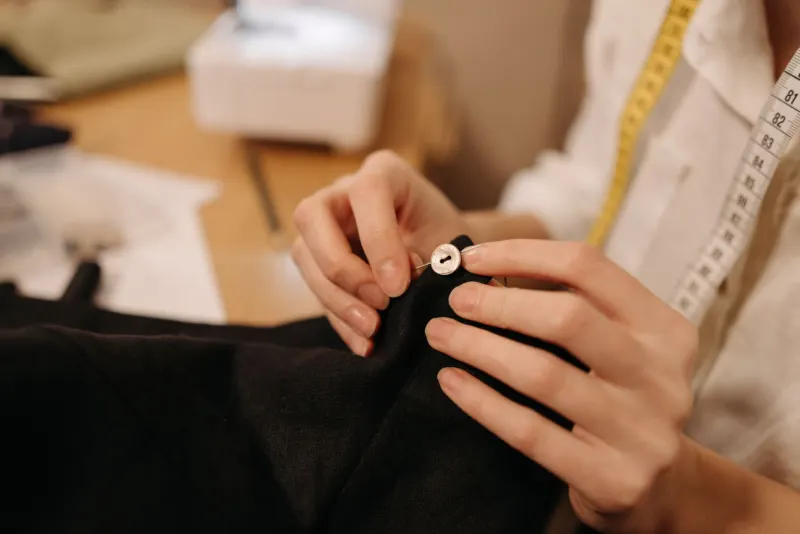
| Needs something | A missing button, a dropped hem, pilling, a stain, a waist that needs taking in, shoes that need heels | Goes into a bag by the front door with a note of what it needs |
| Resting | Out of season, kept for particular occasions, or fits a size you are not at present | Stored properly, labelled, with a date to look again |
| Leaving | You have named the reason you do not wear it, and the reason cannot be fixed | Offered to someone specific, sold, donated or recycled — by a set day |
The “resting” pile is what makes this an audit without mass disposal. Bodies change in both directions, jobs change, and a garment that is wrong for this year is not necessarily wrong. What matters is that resting clothes stop occupying the space where you get dressed, so that the rail shows only what is wearable now.
The “leaving” pile should be the smallest. A useful test: say the reason out loud. “The fabric makes me too hot.” “The colour was chosen for someone I was trying to be.” “It has been altered twice and still pulls.” If you cannot finish the sentence, the garment probably belongs in one of the other three piles.
Give the mending bag a deadline
The weak point of any audit is the bag of things that need something, which can sit in a hallway for a year. Two habits help. First, write the job on a slip of paper and pin it to the garment — “hem 2 cm”, “replace cuff button”, “take in waist” — so nobody has to work it out again. Second, sort the bag into what you will do yourself this week and what goes to a tailor, cobbler or dry cleaner, and put the second group in the bag you carry to work.
Not every repair is worth doing, and it helps to know which are simple and which are major surgery before you commit. Our guide to clothing repairs worth considering before replacing an item goes through the common ones. If a piece has been in the mending bag through two audits, that is information too: move it to “leaving” without guilt.
Put resting clothes away so they come back in good shape
Resting is only kind to a garment if it is stored with some care. Pack by type and season, and write what is in each box on the outside, with the month. “Summer linen, packed October” saves opening five containers in May. A separate, clearly marked box for clothes in a different size means you can go straight to it if you need it, and ignore it if you do not.
How to clean, fold and protect things before they go away is covered in how to prepare seasonal clothes for storage. For the audit itself, the point is simply that “resting” has an address and a review date. Put the date in your calendar. When it arrives, each resting piece goes through the same three questions as everything else.
Put things back in order of use
How the “back in reach” clothes return matters as much as what was removed. Arranging by type is tidy, but it treats the trousers you wear weekly and the ones you wear twice a year as equals. Try arranging by frequency instead: what you wear most at eye level and arm’s length, occasional pieces higher or further along, with the type-sorting happening inside those zones.
While you are doing it, check that each thing is stored in a way that suits it. A heavy jumper on a thin hanger and a tailored jacket folded on a shelf are both common, and whether to hang or fold a garment is worth settling once per category rather than every laundry day.
Notes to make before you close the door
Before the session ends, write down three things while they are in front of you. The pieces you were pleased to rediscover, with one outfit for each — and wear that outfit this week, before it fades from memory. The duplicates, so that you know there are already three black trousers. And anything that failed only for want of a partner: the skirt with no top that suits its waistband, the shirt that needs a different trouser.
That last list is the raw material for working out the real gaps in a wardrobe. Leave it for a few weeks first. Quite often the partner turns up in the next category you audit.