A Men’s Smart-Casual Outfit Guide for Everyday Plans
Smart casual by occasion: the office, a family lunch, an evening out and a daytime event, with one outfit for each and a table for shifting it up or down.
“Smart casual” has no agreed definition, which is why it causes more hesitation than a request for a suit. The working definition used here is this: clothes that are clearly not a suit and tie and clearly not sportswear, with at least one piece that shows you thought about the occasion. That piece might be a collar, a jacket, leather shoes or a pressed pair of trousers. It does not have to be all four.
Because the phrase covers such a wide middle ground, the practical way through it is by occasion. Below are four everyday situations with a combination for each, followed by a way to shift any of them a step up or down.
The sliding scale behind every outfit here
Most menswear pieces can be placed roughly on a line from relaxed to formal. Texture and colour move a garment along it as much as its type does. A navy blazer in a soft, matt cloth is more relaxed than one in a smooth worsted; dark, plain denim reads as smarter than pale, faded denim; a knitted polo sits above a T-shirt and below a shirt.
A smart-casual outfit usually mixes positions on that line: something from the smarter end with something from the relaxed end, and a piece in the middle to join them. If every piece comes from the same end, the result is either a suit without a tie or a weekend outfit. Where an invitation gives no guidance at all, our piece on reading a dress code when the invitation is vague suggests how to work out which end to lean towards.
An office with no written dress code
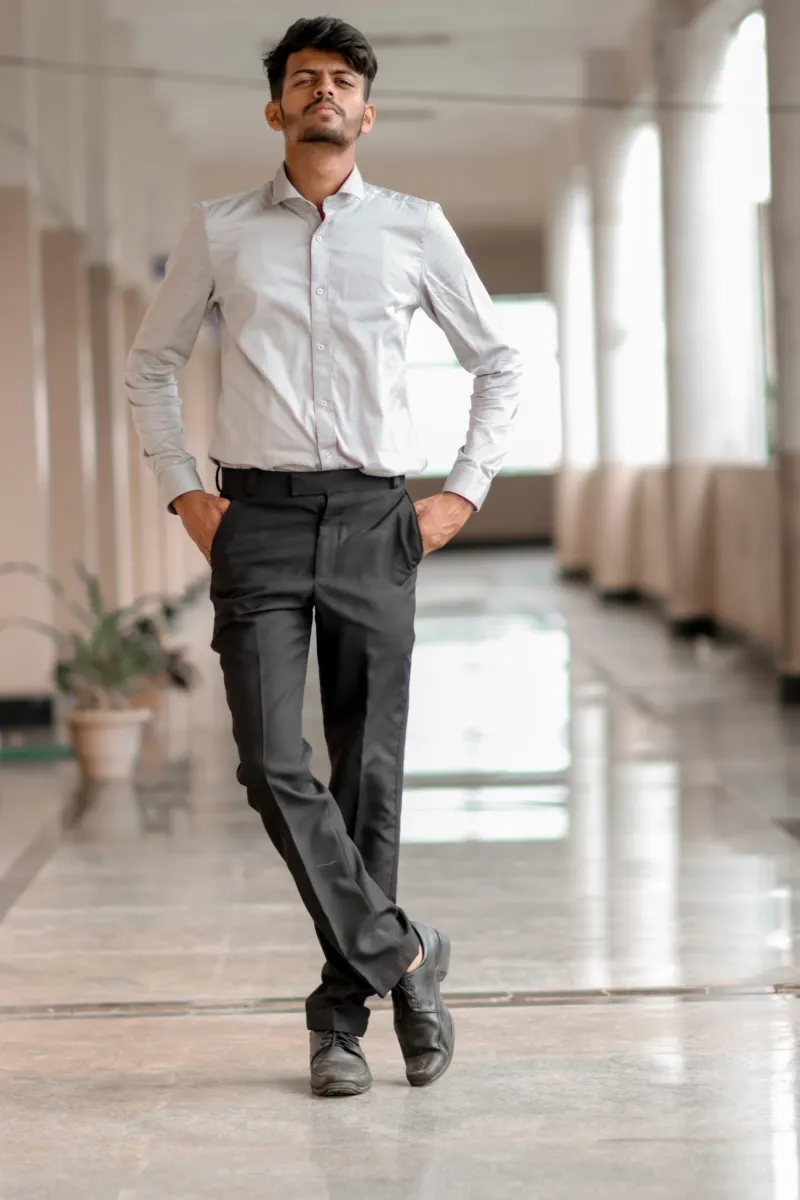
The aim is to look ready for a meeting without looking dressed for an interview. Trousers with a crease or a clean drape and a collar of some kind do most of that, and they leave room for colour.
Chinos, an Oxford shirt and a knit
A collar framed by a crew-neck jumper is tidy at the neck and comfortable at a desk, and it works with or without a jacket over it.
- Pieces
- Navy or olive chinos, a pale blue Oxford-cloth button-down shirt, a fine-gauge crew-neck jumper (sweater) in burgundy or forest green, brown leather derbies or loafers, a brown belt.
- Swaps
- Grey wool trousers for a smarter day. A white shirt if you prefer a plainer base; our guide to finding a white shirt that works for your routine covers collar and cloth. A knitted long-sleeved polo in place of shirt and jumper in warm weather. Minimal leather trainers (sneakers) where the office is relaxed.
- The detail
- The shirt hem. Tucked in with a belt reads as work; untucked under a jumper with only the collar showing reads as weekend. A shirt cut long enough to tuck is usually too long to wear out.
Lunch with family, or meeting someone’s parents
Here the outfit has to say that you made an effort without looking stiff on a sofa. Soft tailoring is useful: a jacket you can take off and hang on a chair, over something that still looks complete without it.
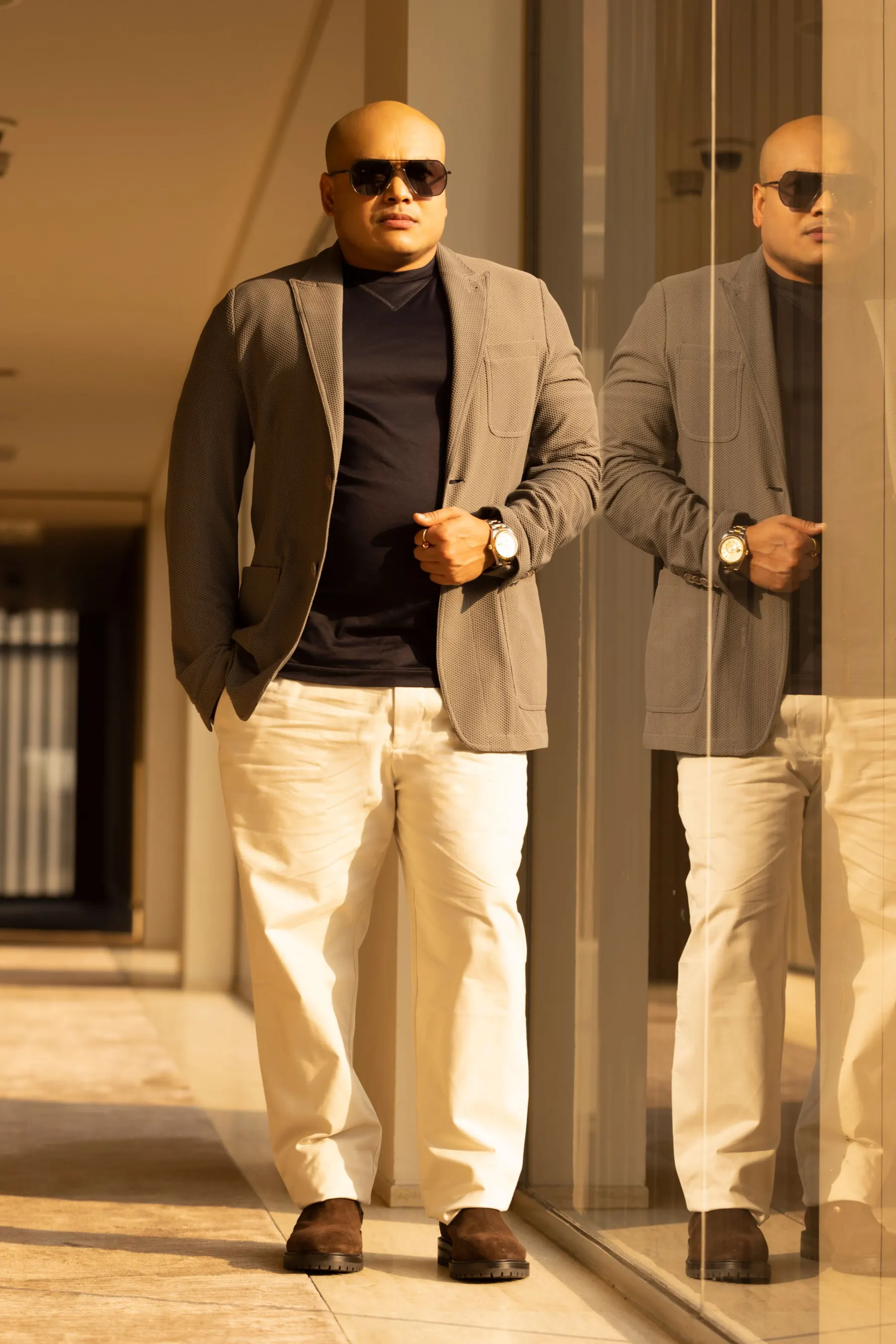
Unstructured blazer, knitted polo, dark jeans
One tailored piece, one soft collar, one casual trouser. Each sits at a different point on the scale, which is why the combination feels balanced.
- Pieces
- A soft-shouldered blazer in navy, brown or a muted check, a knitted polo shirt in cream, rust or dark green, dark indigo jeans without fading or rips, brown suede loafers or chukka boots.
- Swaps
- A plain T-shirt in a heavy cotton under the blazer for somewhere more relaxed. Corduroy trousers in tan or olive instead of jeans. A cardigan with a shawl collar in place of the blazer when a jacket feels like too much.
- The detail
- The condition of the jeans. The same cut in a dark, even wash, hemmed to the right length, belongs in this outfit; a faded pair with a frayed hem pulls it firmly back to casual.
A date, or drinks in the evening
Evening tends to suit darker colours and fewer of them. Texture matters more in low light than pattern does, so this is a good moment for suede, corduroy, flannel or a knit with a visible rib.
Dark overshirt, roll-neck, tailored trousers
A close, dark outline with one change of texture. It is smart without involving a shirt collar or a blazer at all.
- Pieces
- A wool or heavy cotton overshirt in charcoal, navy or dark olive, a fine roll-neck in black or deep burgundy, charcoal or black tailored trousers with a slight taper, black leather Chelsea boots.
- Swaps
- A dark shirt with the top two buttons open in warm weather, sleeves rolled. Black jeans in place of tailored trousers. A suede or leather jacket as the outer layer if you own one.
- The detail
- How much colour there is. Keeping the whole outfit within two dark tones, such as charcoal and burgundy, looks calm and intentional. A third, brighter colour is not wrong, but it changes the mood from evening to daytime.
A daytime occasion: a christening, a gallery opening, a summer party
Daytime events with other people’s photographs in them usually sit at the smart end of smart casual. Lighter colours are at home in daylight, and a jacket is the simplest way to show respect for the occasion. It can come off after the first hour.
Light trousers, a striped shirt and a contrasting jacket
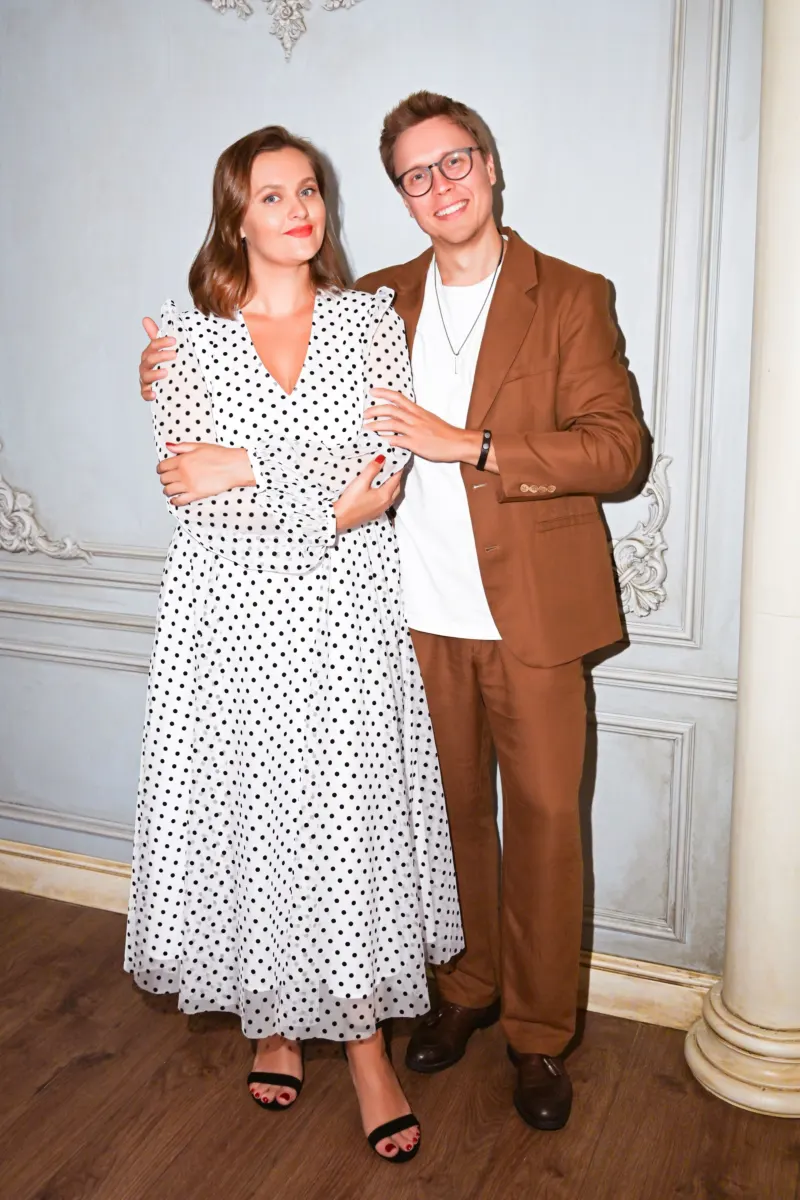
Separates in different colours, so it is plainly not a suit, with everything pressed.
- Pieces
- Stone or light grey trousers in cotton or a wool blend, a blue-and-white striped shirt, a blazer in navy, sage green or tobacco brown, brown leather loafers, a woven or leather belt.
- Swaps
- A linen shirt and no jacket for a hot outdoor party. A knitted tie if the host is traditional. Suede derbies in place of loafers. In cooler months, flannel trousers and a waistcoat (vest) or sleeveless knit under the jacket.
- The detail
- Belt and shoes in the same family of colour and finish. They need not match exactly, but a brown suede shoe with a brown leather belt looks settled, while black shoes with a tan belt draws the eye to the middle. Our piece on how belts change the proportions of an outfit goes further.
One step up, one step down
When you are unsure of the level, build the outfit for the middle and know which single change would move it. This table gives the commonest exchanges.
| Part of the outfit | A step more relaxed | The middle | A step smarter |
|---|---|---|---|
| Top | Heavy plain T-shirt | Knitted polo or Oxford shirt | Plain poplin shirt, with or without a tie |
| Layer | Overshirt or cardigan | Soft, unstructured blazer | Structured blazer in a smooth cloth |
| Trousers | Dark jeans | Chinos or corduroys | Wool trousers with a crease |
| Shoes | Plain leather trainers | Suede loafers, chukka or Chelsea boots | Polished leather derbies or Oxfords |
Moving one row at a time is enough. Changing jeans to wool trousers and keeping the rest moves an outfit a full step; changing every row at once produces a different outfit altogether.
Fit and upkeep do more than the garments
Across all four situations, fit and upkeep count for as much as the choice of garments. Trousers hemmed so they do not pool, a collar that lies flat, shoes that have been brushed, a jumper without bobbles: none of these requires owning anything new.
It also means a small number of pieces goes a long way. Two pairs of trousers, three tops with collars, one jacket and two pairs of shoes cover everything above, and the same reasoning runs through building a small work wardrobe with more outfit options. If in doubt on the day, carry the jacket: it is easier to take a layer off than to wish for one.