How Belts Change the Proportions of an Outfit
The same shirt and trousers with and without a belt, and what position, contrast and width each do to the way an outfit divides.
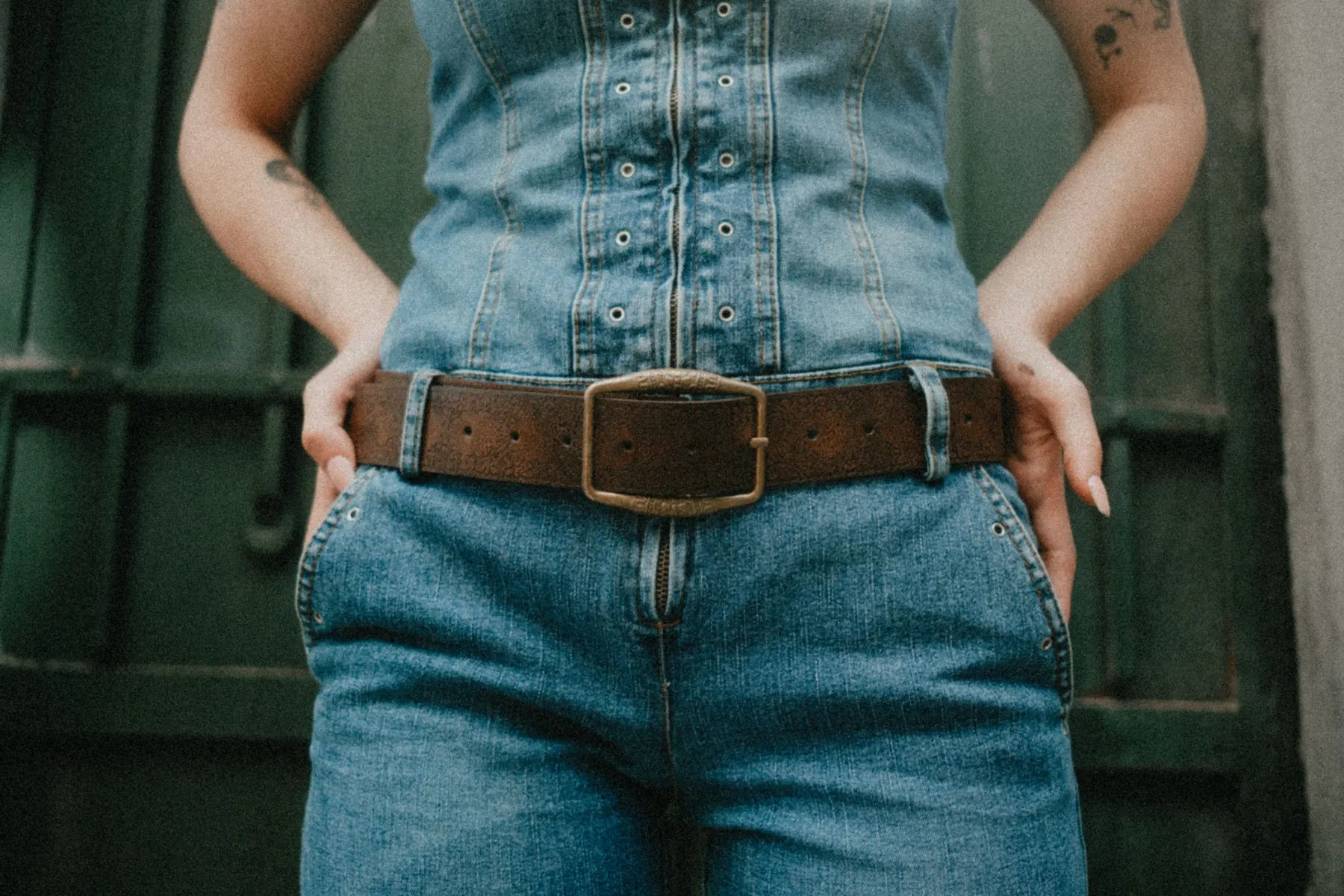
A belt is a horizontal line that you get to place. Everything else it does, from holding trousers up to adding a strip of colour, is secondary to that. The quickest way to see the effect is to keep an outfit exactly the same and change only the belt.
One outfit, twice
Take a white shirt, navy straight-leg trousers and brown leather loafers. The shirt is tucked in both times; nothing else moves.
Without a belt
The eye runs from collar to shoe with one soft change of colour where white meets navy. The outfit reads as two long blocks and looks relaxed, a little unfinished if the trousers have empty belt loops, clean if they have none.
- Pieces
- White cotton shirt, navy straight-leg trousers with a plain or side-adjusted waistband, brown loafers.
- Swaps
- A fine jumper (sweater) worn untucked over the waistband makes the question disappear altogether. Trousers with a drawstring or elasticated waist are designed to go without.
- The detail
- The loops. Five empty loops on a tucked shirt look like something is missing; on trousers without loops the same bare waist looks intended.
With a tan leather belt about 3 cm wide
Now there is a third element: a warm, narrow band exactly where the two blocks meet. The join becomes a feature, the waist is marked, and the belt picks up the brown of the shoes so the outfit is held at two points.
- Pieces
- The same shirt, trousers and loafers, plus a tan belt with a small plain buckle.
- Swaps
- A navy belt close to the trouser colour marks the waist far more quietly. A woven or suede belt takes the outfit towards the weekend; a black belt wants black shoes or at least something else black nearby.
- The detail
- Contrast. Tan against navy and white is a strong line; the stronger the contrast, the more firmly the outfit is divided into top and bottom.
What actually changed
Three things, and they are the three settings every belt has. Position: where on the body the line falls. Contrast: how much the belt differs in colour or depth from what is above and below it. Width: how much of the outfit the line takes up.
None of these is right or wrong. A high, contrasting, wide belt makes a very clear statement about where the top ends; a low, tonal, narrow one barely interrupts. Thinking of the belt this way sits inside the wider idea of dividing an outfit into sections, which we go through in understanding proportion without rules about your body.
Position: where the line sits
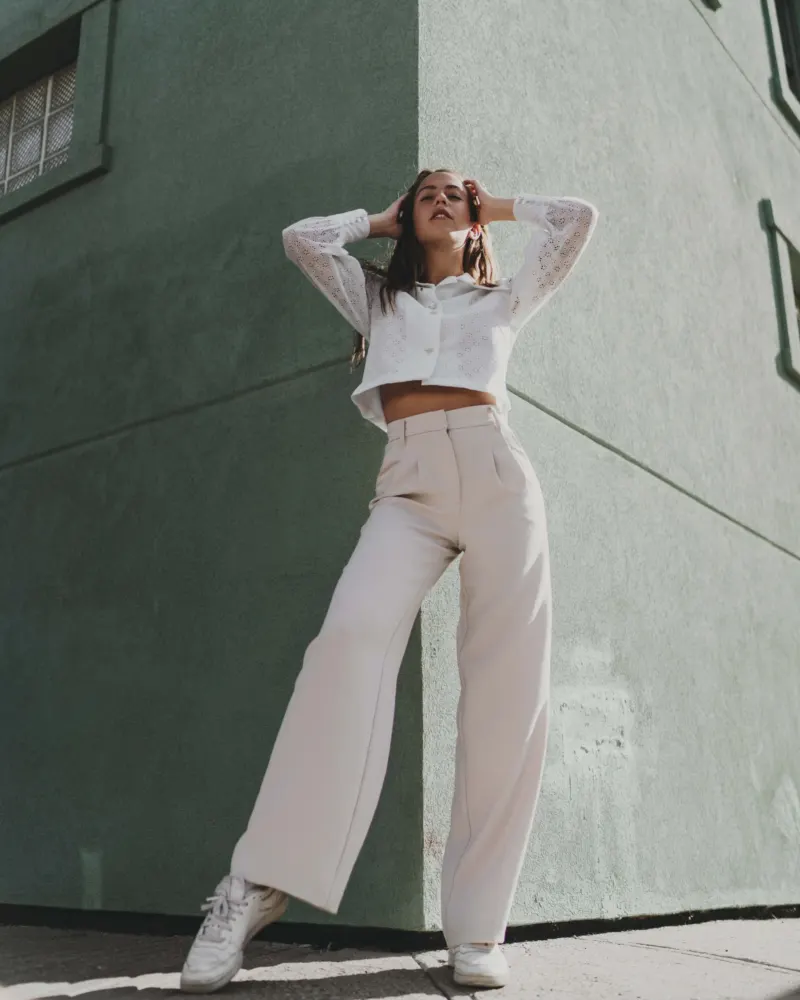
With trousers, the belt goes where the waistband goes, so the rise of the trousers does the deciding. High-rise trousers with a belt give a short top section and a long leg section. Low-rise jeans with a belt put the line at the hip, giving a longer top section and a shorter leg section. Neither is better; they are different divisions of the same outfit. This is one reason high-waisted wide-leg trousers so often appear with a tucked top and a belt: the line shows where all that fabric begins.
Over a dress, a long shirt, a cardigan or a coat, you choose the position yourself. Try the same belt in three places in front of a mirror: just under the ribs, at the natural waist, and resting loosely on the hips. Each produces a different garment out of the same dress. A belt on the hip that is allowed to dip slightly at the front looks easy; one pulled tight at the waist gathers the fabric into folds above and below, which adds volume in both directions.
Width, contrast and buckle
As a matter of habit rather than law, narrower and smoother belts tend to be worn with tailored trousers, and wider, more textured ones with jeans, chinos and workwear. The loops settle part of this for you: a belt much narrower than the loops slides about and looks borrowed, and one that is too wide will not go through.
Over a dress or coat there are no loops to obey. A narrow belt, about 1.5 to 2 cm, draws a fine line and suits lighter fabrics; a wide one, 5 cm or more, becomes a panel in its own right and holds its ground on thick wool or a heavy knit. A wide belt in the same colour as the dress shapes the garment without adding a stripe.
The buckle is a small piece of jewellery. If you wear a watch, rings or a bag with metal fittings, it is pleasant when the metals are in the same family, but nothing breaks if they are not. A large decorative buckle becomes the centre of the outfit, so it is worth deciding whether you want the centre to be there.
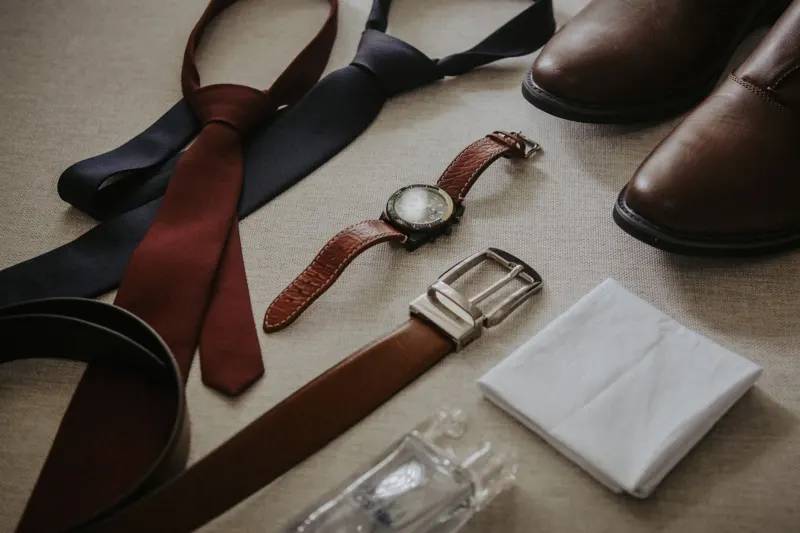
The old convention of matching belt leather to shoe leather is a reliable way to make an outfit look deliberate, particularly with a suit. It is a convention, not a requirement. Same depth of tone, such as mid-brown with tan or burgundy with dark brown, usually reads as matched from any normal distance.
Belts over layers
A long cardigan, belted
A belt turns an open, straight cardigan into something closer to a wrap jacket and keeps it closed without buttons.
- Pieces
- Long grey cardigan in a medium-weight knit, white T-shirt, black straight jeans, a black leather belt about 3 cm wide worn over the cardigan, ankle boots.
- Swaps
- The cardigan’s own tie belt if it has one. A shirt dress or an oversized shirt instead of the cardigan. A woven fabric belt in summer.
- The detail
- Pull a little of the cardigan up and over the belt so it blouses slightly; a knit cinched flat tends to ride up and look strained.
A coat with its belt tied, not buckled
The belt of a trench or wrap coat is as much a styling device as a fastening, and how it is tied changes the coat’s formality.
- Pieces
- Belted trench or wool wrap coat, whatever is underneath, the coat’s own belt.
- Swaps
- Buckled properly for a sharper, more formal line. Knotted behind the back to pull the coat in at the sides while it hangs open at the front. Swapped for a leather belt in a contrasting colour, if the loops allow.
- The detail
- A single knot with the ends left hanging looks casual and is quick to undo; tucking the buckle end away keeps it from swinging.
When to leave it off
A belt under an untucked top adds a ridge and does nothing visible, so many people skip it with jumpers and untucked shirts, provided the trousers stay up on their own. If they do not, that is a fit question, and the waistband is among the things worth checking when choosing everyday trousers.
Leaving the belt off also makes sense when the outfit already has a strong horizontal: a cropped jacket hem, a contrast waistband, a peplum, a tucked top in a very different colour from the trousers. Two lines a few centimetres apart compete. And an outfit in one colour from shoulder to hem is sometimes better left as one unbroken column, with a belt in the same shade if anything at all.
The useful habit is to put the belt on last, look, take it off, and look again. Whichever version you want to keep looking at is the answer for that outfit on that day.