Why Clothes Pill and How to Handle It Carefully
Pilling is friction plus loose fibre plus something strong enough to hold the tangle on. Where it comes from, where to expect it, and how to remove it gently.
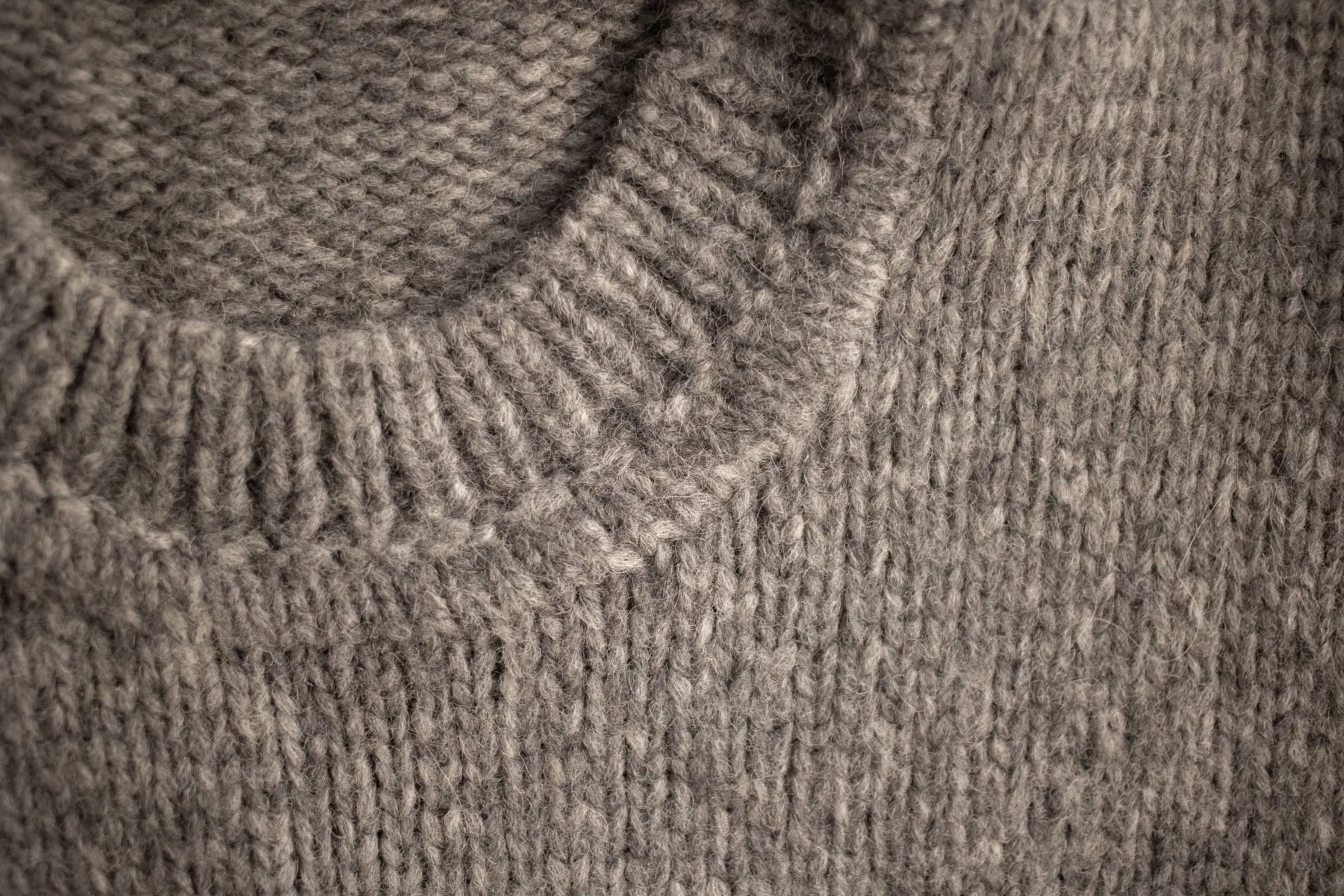
Why does one jumper stay smooth for years while another, worn half as often, is covered in tiny balls of fluff by its third outing? The usual answer is that the second one was simply badly made. The more accurate answer is less satisfying and more useful: pilling is the result of several things acting together, most of them invisible when the garment is new.
The Woolmark Company, speaking for the wool industry, calls it “a very complex phenomenon” that depends on many factors and says plainly that nobody can guarantee it will not happen. So this piece does not promise a cure. It explains the mechanism, which makes it easier to see where pills will form, and then sets out the careful ways of dealing with them.
What a pill actually is
CottonWorks, the resource for textile professionals that Cotton Incorporated publishes to promote cotton, defines pills as small balls of entangled fibres attached to the surface of a fabric. The important word is attached. A pill has two parts: a tangle of loose fibre, and one or more anchor fibres that are still rooted in the yarn and hold the tangle in place.
The same CottonWorks material describes how they form. Pilling and fuzzing are common in fabrics made from spun yarns, where many fibre ends protrude from the surface. In wear, protruding fibres roll up with one another and with loose lint. Where the anchor fibres are too strong to break off, the lint collects on them as a pill; the implication is that a weaker anchor would let the tangle fall away.
Why some fabrics pill more than others
That last step explains the most counter-intuitive point in the cotton industry’s account: strong fibres can make pilling worse, because they hold on.
- Blends with synthetics. The CottonWorks guidance is that yarns combining cotton with a man-made fibre tend to pill more than pure cotton, because the strength of the synthetic fibre makes a better anchor. In its test examples a 100 per cent cotton jersey scored noticeably better than the same fabric in cotton-polyester blends.
- Pure cotton. The same source says that 100 per cent cotton fabrics typically do not pill, which fits its own account of the mechanism. It is also a cotton body’s statement about cotton, and worth reading with that in mind.
- Fine animal fibres. Cashmere and fine wools may pill, according to the same material, because of the strength of the fibre and their long surface hairs. A soft, hairy surface is a surface with plenty of fibre ends available.
- Low twist and short fibres. Loosely twisted spun yarns fuzz more in wash and wear. Among the measures listed for manufacturers are keeping short-fibre content down and increasing twist; Woolmark’s advice to designers is similar: longer fibres, the highest twist the yarn can take, and fabrics with a higher “cover factor”.
- Filament yarns, which are continuous instead of spun from short lengths, are not exempt: they can pill if individual filaments break in use.
None of this can be read reliably from a composition label. Two jumpers with identical percentages can behave quite differently depending on the yarn and the knit, which is one of the limits discussed in what a fabric blend can tell you. Pilling is better understood as a characteristic of a particular fabric than as a verdict on a fibre.
Where to expect it
Pills appear where there is friction. Woolmark lists the common places on a jumper: elbows, underarms, sleeves, the belly and the sides, where the arms keep touching the body. CottonWorks adds the area under the sleeves and around the collar on shirts and the crotch area of trousers.
Your own habits join in. Woolmark notes that more active wearers generally see more pilling, as do garments in repeated contact with an abrasive surface, and gives sitting for long periods at a desk as its example. A bag strap worn across the body, a seat belt or a rough coat lining seem to us the same kind of thing: a patch of pilling in one odd place may be a map of something that rubs there.
Washing contributes as well. The CottonWorks material says that most pills form in laundering, where tumbling abrades the fabric wet and dry and generates plenty of loose fibre to feed them.
Reducing the rubbing
You cannot change the yarn, but you can reduce the abrasion. Follow the garment’s care label first; within what it allows, these are the measures the sources suggest.
- Turn wool clothes inside out before washing. This is Woolmark’s first recommendation; the idea, as we read it, is to move the friction of the wash to the side that does not show.
- Skip fabric softener on wool. Woolmark advises against it in the context of pilling.
- Minimise abrasion in wear where you reasonably can. Swapping the shoulder a bag sits on, or not wearing the same jumper under the same rough-lined jacket every day, costs nothing.
- Use the gentle cycle the label indicates, with the smaller load that goes with it. On the international care symbols, bars under the washtub signify reduced mechanical action, and GINETEX pairs them with a reduced quantity of laundry.
Since CottonWorks names tumbling as a source of abrasion, drying flat or on a line where the label permits is a reasonable inference, though it is ours and not a tested claim; the wider routine is in our guide to washing, drying and storing knitwear.
Removing pills without damaging the fabric
Every method of removal takes something away from the surface, so the aim is to take the pill and as little else as possible. Woolmark describes three approaches, in ascending order of force.
By hand
Woolmark’s view is that pills can easily be removed by hand when not too many have formed, and it suggests making that routine, after the garment has dried or just before ironing. Our own suggestion is to lift each one away from the fabric instead of dragging it along the surface, so that as little fresh fibre as possible comes with it.
With a comb
A comb can be used, but Woolmark’s instruction is to do it “very gently and carefully”. We take that to mean the garment flat on a table and light strokes, since a comb drawn hard across a loose knit could catch a loop.
With a fabric shaver
Woolmark describes small battery-operated de-pillers as low in cost and very effective. In our view they are also the method most capable of harm, because a blade cannot tell a pill from a raised stitch. The cautions below are ours, not Woolmark’s.
One caution applies to every method. The fibre in a pill came out of the garment, and removing pills does not put it back. No method is promised to stop them returning. A cloth that has been shaved many times may be thinner at the elbows than it was, and thinning at an elbow is better met with a patch or a darn than with another pass of the blade. That is the point at which our piece on repairs worth considering takes over.
Judging a fabric before it is yours
We know of no test you can do in a shop that predicts pilling with confidence; the industry itself relies on laboratory machines that tumble or rub samples for a set time and grade the result on a five-point scale. What you can do is look and feel with the mechanism in mind.
These are our own rules of thumb, built on the factors above and not a tested method: a very fuzzy, lofty surface suggests more loose fibre ends than a smooth, compact one, and a yarn that looks loosely twisted suggests less holding its fibres in. On a pre-owned garment the evidence is already there: check the underarms, the sides and the inner thighs, which is one of the advantages of shopping second-hand with a plan. A piece that has been worn and is still smooth in those places has shown you how it behaves.
Sources
- The Woolmark Company What is pilling?
- CottonWorks (Cotton Incorporated) Fabric Defects 101: Understanding & Overcoming Pilling (webinar slides, PDF)
- GINETEX Care symbols
- CottonWorks (Cotton Incorporated) Natural vs. Synthetic Fibers