What a Fabric Blend Can Tell You About a Garment
Three example composition labels read line by line: why the fibres were mixed, what the percentages suggest about wear and care, and what no label can tell you.
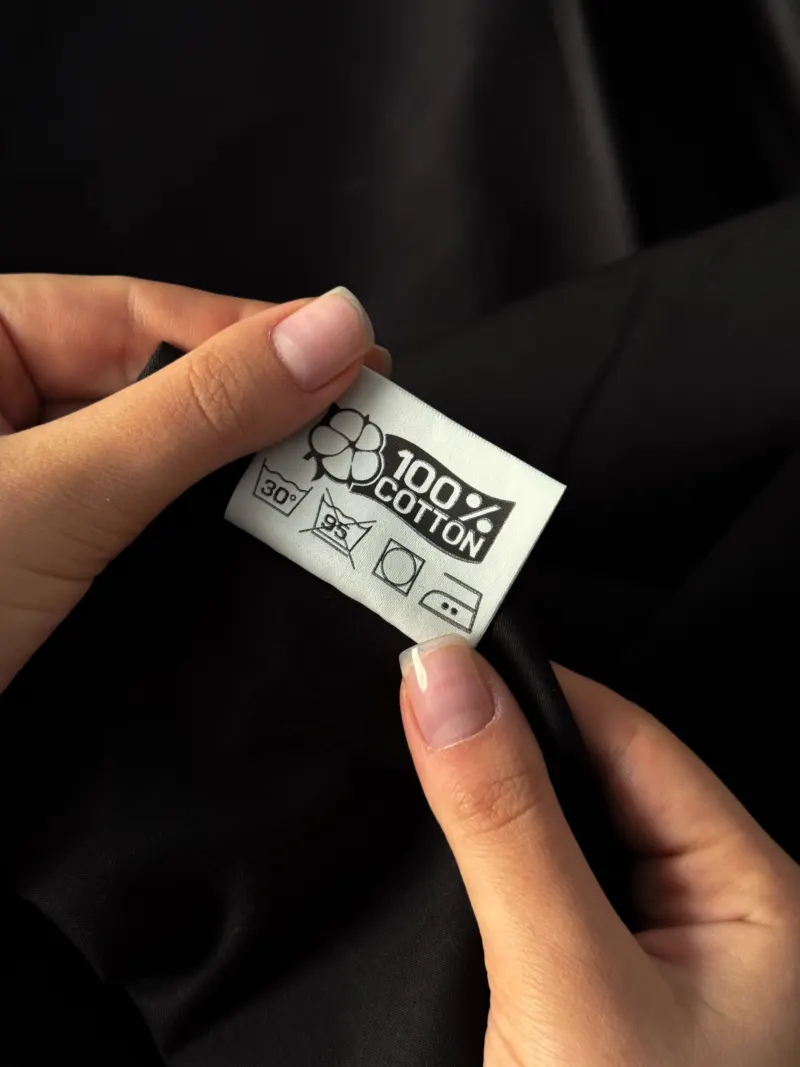
Three composition labels, of the kind sewn into a side seam next to the care symbols:
- 60% cotton, 40% polyester, inside a sweatshirt.
- 98% cotton, 2% elastane, inside a pair of jeans.
- 80% wool, 20% polyamide, inside a winter coat.
Each is a recipe with the quantities given and the method left out. A blend exists because someone wanted a property that one fibre alone did not supply, and with a little background you can usually work out what that property was, what it is likely to cost you elsewhere, and what the label is silent about. These three are invented examples, chosen because their patterns turn up constantly.
First, how a composition label is put together
In both the European Union and the United States the fibres must be listed in descending order of percentage, so the first name is the one there is most of. The US rules specify percentages by weight of fibre, which is not the same thing as surface area or how the cloth feels.
A few rules explain the oddities you will come across:
- Names vary by country, not by fibre. Viscose and rayon are the same thing; so are elastane and spandex. US rules accept either name in each pair. Polyamide and nylon are likewise paired in the teaching summary used below.
- “Pure”, “all” and “100%” may be used in the EU only for a product made exclusively of one fibre.
- Small amounts may be lumped together. Under the US Federal Trade Commission’s rules, a fibre making up less than 5 per cent is normally disclosed only as “other fibre”, unless it has a functional significance at that level; wool is always named. The FTC’s own example is a few per cent of spandex, named because it supplies elasticity.
- The figures are approximate. The FTC allows a tolerance of 3 per cent on fibre-content claims, though not on a label naming a single fibre.
- Not everything is counted. In the US, trim such as collars, cuffs, braiding and binding is excluded, and linings used only for structure need not be disclosed. A label may say “exclusive of decoration” or list sections separately: “shell”, “lining”, “sleeves”.
The practical point of that last rule: when a label is split into parts, read the part that touches your skin and the part that takes the wear, not only the first line.
Label one: 60% cotton, 40% polyester
We read this as a comfort-plus-convenience recipe. On a fibre-properties summary published for Scottish textile teaching, cotton rates excellent for absorbency and breathability but poor for crease resistance and elasticity. Polyester is close to the mirror image: poor for absorbency and breathability, excellent for crease resistance, strength, durability and ease of care. Mix them and the hope is a cloth that feels like cotton, creases less and is easier to look after.
What you might notice in wear follows from the same ratings. On them, more polyester should mean a less absorbent cloth, which some people feel as clamminess in warm weather and others never notice.
The less obvious trade is on the surface. CottonWorks, which Cotton Incorporated publishes to promote cotton and which has an interest in the comparison, states that spun yarns of cotton and a man-made fibre tend to pill more than pure cotton, because the strong synthetic fibre anchors loose lint to the surface instead of letting it break away. The mechanism, and what to do about it, is set out in why clothes pill.
Care: follow the label, and do not assume a cotton blend takes cotton’s heat. In GINETEX’s guide to the international care symbols, the hot iron setting, up to 210 °C, is the cotton and linen one, while polyester sits at the moderate setting, up to 160 °C. GINETEX also says the iron setting should be taken from the care label and not from the fibre content at all, which settles the matter for any blend.
Label two: 98% cotton, 2% elastane
Here the small number is the interesting one. Elastane is a stretch fibre: the definition quoted by CIRFS, the association of Europe’s man-made fibre producers, is of a fibre that can be stretched to three times its original length and then reverts rapidly to substantially that length when released. Even a couple of per cent is there to do a job, which is exactly why a fibre present in such a small quantity is named on the label at all.
What it suggests about the garment: jeans or trousers that give at the knee and seat when you sit and recover afterwards, and that can be cut closer to the body without restricting movement. Whether that is what you want is a matter of preference. Some people prefer rigid, all-cotton denim for the line it holds; others find stretch denim easier from the first wear. Neither is the superior article. For how fabric, cut and ease of movement fit together when you are trying things on, see our guide to choosing everyday trousers.
The same association notes that elastane yarns are often covered with another fibre, which it says adds bulk and improves abrasion resistance. The thing to watch over the life of the garment is recovery: fabric that bags at the knee and stays bagged. We found no reliable public source that sets out exactly what shortens the life of the stretch in everyday laundering, so we will not guess; the cautious course is to stay within the care label’s temperatures for washing, drying and ironing, remembering that lower temperatures than the label shows are always permitted.
Label three: 80% wool, 20% polyamide
The same teaching summary rates wool excellent for warmth, elasticity and crease resistance but only fair for strength. Nylon (polyamide) is rated excellent for strength and durability. Put a minority of nylon into wool and the likely intention, as we read those ratings, is reinforcement: a cloth meant to stand up to wear while still behaving like wool.
What it suggests about the garment is that it was made to be worn hard. What it does not tell you is how the cloth was made, and in our view that is most of the story with wool: two coats with this identical label can differ completely in the hand.
Two care points follow from the majority fibre. First, it is still mostly wool, so the wool rules apply unless the label says otherwise: check whether it is washable at all, and if so use the gentle treatment described in our knitwear care guide. Second, moths love wool, in English Heritage’s phrase, and its conservators advise storing clothing clean; the University of Kentucky’s extension guide speaks of moth damage to wool and wool-blended fabrics alike, so we would give a blend the same care as a pure wool piece.
What no composition label can tell you
A label lists ingredients. It does not describe:
- The weight and density of the cloth. A thin cotton voile and a heavy cotton drill are both “100% cotton”.
- Whether it is woven or knitted, and how. CottonWorks’ material on shrinkage notes that knitted fabrics of all constructions and blends are inherently more prone to shrinking than woven ones.
- The quality of the fibre and yarn. CottonWorks notes, for instance, that the staple length of cotton affects yarn strength and evenness, and none of that appears in a percentage.
- Finishes applied for softness, crease resistance or water repellency.
- How it should be cleaned. That is the care label’s job, and GINETEX points out that its symbols reflect the most sensitive element of the whole garment, including dyes, trims, buttons and zips.
- How it was produced. A fibre name is not evidence of anything about a garment’s environmental record, in either direction.
If the names of the base fibres are still a blur, cotton, linen and viscose compared is the place to start.
Sources
- US Federal Trade Commission Threading Your Way Through the Labeling Requirements Under the Textile and Wool Acts
- European Union - Your Europe Textile Label
- Qualifications Scotland (formerly SQA) Summary of fibre properties
- CottonWorks (Cotton Incorporated) Fabric Defects 101: Understanding & Overcoming Pilling (webinar slides, PDF)
- CIRFS (association of European man-made fibre producers) CIRFS: Elastane
- GINETEX Care symbols
- GINETEX Care labelling
- CottonWorks (Cotton Incorporated) Shrinkage & Skewing
- CottonWorks (Cotton Incorporated) Cotton Fiber Quality
- English Heritage Clothes moths - prevention and control (PDF guideline)
- University of Kentucky Cooperative Extension Service Clothing Storage (CT-LMH.144, revised 01/02)
- CottonWorks (Cotton Incorporated) Natural vs. Synthetic Fibers