How to Read a Clothing Care Label
Five symbols, always in the same order, each answering one question. A left-to-right reading of the international care label, plus how US labels differ.
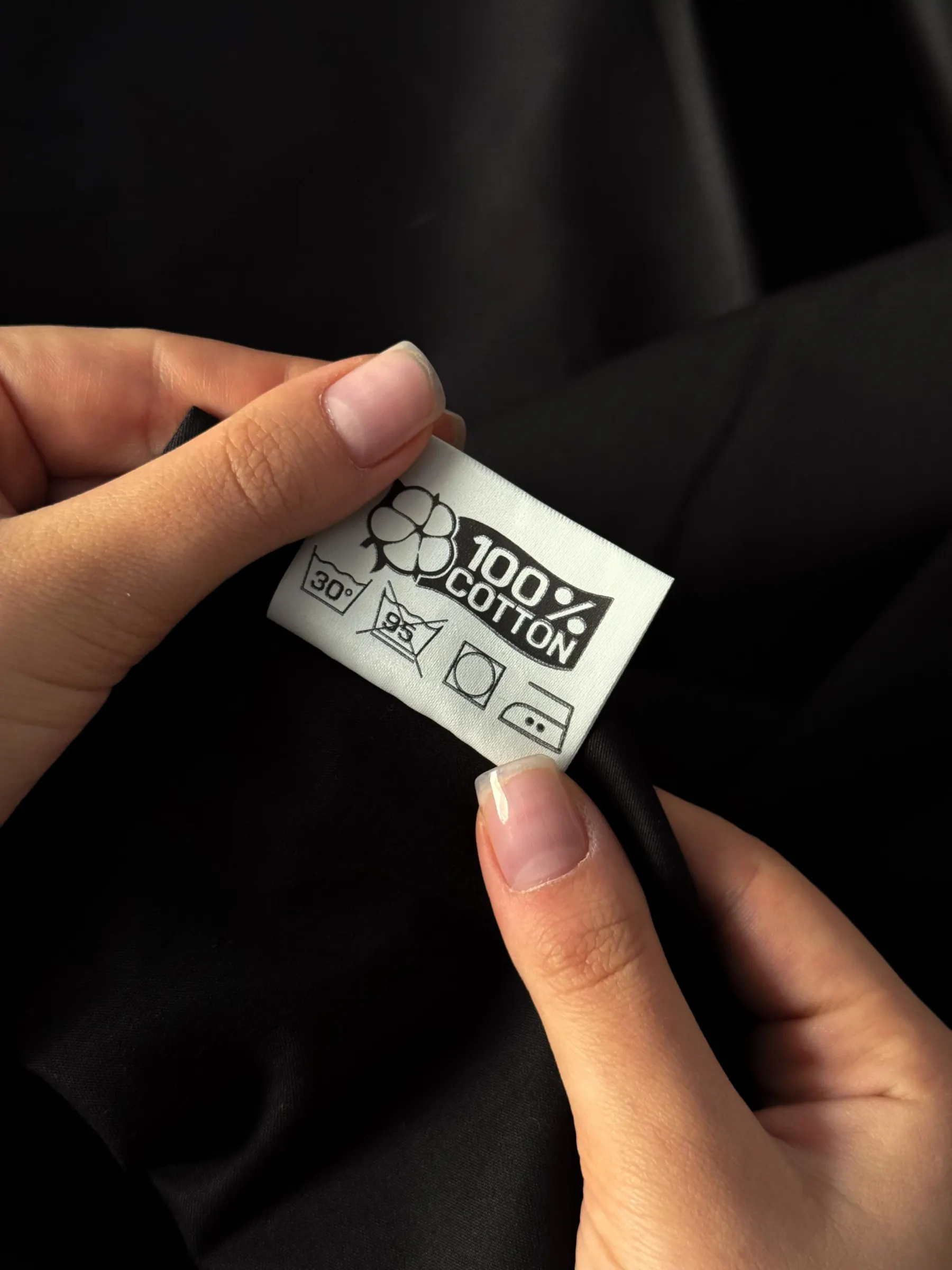
A care label is a short sentence written in pictures. It has five words, they come in a set order, and each one answers a single question: can this be washed, bleached, dried in a machine, ironed, and cleaned professionally?
The system described here is the international one. The symbols belong to GINETEX, which describes itself as the international association for textile care labelling, and they are the basis of the standard ISO 3758, whose current edition dates from 2023. GINETEX asks for the full series of symbols on every label in a fixed sequence, and its own guide sets them out as washing, bleaching, drying, ironing and professional care, the order followed here. The United States works differently, and that is covered further down.
The grammar: five shapes, three kinds of modifier
Each of the five treatments has its own base shape. Everything else on the label is a modifier added to one of those shapes.
- A cross through a symbol means that treatment is not allowed. The UK consumer body Which? spells this out for the tub, the triangle, the tumble dryer, the iron and the circle alike.
- A bar underneath means a milder process. One bar is mild; two bars is very mild.
- A number or dots inside give a temperature limit. In the washtub it is a number in degrees Celsius. In the iron and the tumble-dryer symbol it is dots, which stand for a temperature range or heat level instead of an exact figure; in Which?’s summary, the more dots, the more heat.
Two principles from GINETEX make the whole label easier to use. First, the symbols show the maximum permitted treatment; milder treatments and lower temperatures than the label shows are always allowed. Second, the symbols refer to the most sensitive part of the garment, which may be the dye, a finish, the buttons or a zip, not necessarily the main fabric. That is why two cotton shirts can carry different labels.
Reading from left to right
1. The washtub: washing
The tub covers domestic washing by hand or machine. The number inside is the maximum wash temperature in degrees Celsius, and it must not be exceeded. GINETEX’s guide lists 30, 40, 60, 70 and 95.
A single bar under the tub indicates a milder cycle with reduced mechanical action, the kind intended for easy-care and mechanically sensitive articles; GINETEX also advises a smaller load and little or no spinning. A double bar indicates a very mild cycle, with machine-washable wool given as the example, and at 40 °C the drum should be no more than one-third full.
The hand-wash symbol comes in two versions. One specifies a maximum of 40 °C; the other specifies water at ambient temperature, around 20 to 30 °C. In both cases GINETEX’s instructions are to dissolve a fine detergent in plenty of water, let the item float and move it carefully, and not to rub, pull or wring. A cross through the tub means do not wash: GINETEX’s explanation is that the article may be sensitive to any wet treatment.
2. The triangle: bleaching
There are only three versions. An empty triangle allows any bleach, chlorine or oxygen. A triangle with two oblique lines inside allows oxygen bleach only, which is the kind contained in universal detergents, and rules out chlorine bleach. A triangle with a diagonal cross means do not bleach, and GINETEX adds that only bleach-free detergent should be used.
3. The square: drying
The square is the symbol of the drying process, and it comes in two families.
A circle inside the square refers to tumble drying. The dots inside indicate the severity of the heat: the normal process allows drying at normal load and temperature (GINETEX gives 80°), while the mild process calls for caution and a reduced temperature (60°) and duration. Crossed out, it means the article is unsuitable for tumble drying.
Horizontal or vertical lines inside the square, with no circle, refer to natural drying. There are four basic versions: line drying, drip line drying, flat drying and drip flat drying. Flat drying is the one to look for on knitwear; woollen and delicate textiles are among GINETEX’s examples for it. An added oblique line means the same process should be carried out in the shade, which GINETEX’s examples associate with textiles that are not colourfast, silk and other delicate pieces.
If there is no tumble-dry symbol at all, GINETEX’s guidance is to take your cue from the washing and ironing symbols: the gentler those are, the more caution drying needs.
4. The iron: ironing
The dots give the temperature range, and GINETEX is firm that the setting should be chosen from the label and not from the fibre content.
The lowest setting allows a sole plate of up to 120 °C, corresponding to the acrylic, nylon and acetate setting on an iron; steam at this level may cause irreversible damage, and one version of the symbol excludes steam altogether. The moderate setting allows up to 160 °C, the wool, silk, polyester and viscose setting, with the advice to iron under a slightly damp cloth and avoid heavy pressure. The hot setting allows up to 210 °C, the cotton and linen setting, ironing while damp; this is the symbol Which? describes as three dots, for linens and cottons. A crossed-out iron means do not iron: irreversible changes must be expected.
5. The circle: professional care
Letters inside the circle are, in GINETEX’s words, intended for professional textile cleaners: they say which solvents may be used, either perchloroethylene and hydrocarbons or hydrocarbons only. A second circle symbol covers professional wet-cleaning, a water-based process whose equipment and finishing cannot be reproduced in a household washing machine; where it is used, it appears immediately below the dry-cleaning symbol. A bar beneath either circle signals that the process must be limited in some way, such as mechanical action, added moisture or drying temperature. A crossed-out circle means do not dry-clean, and GINETEX adds a point that concerns you at home too: do not use solvent-based stain removers on that article.
The five families at a glance
| Position | Shape | Question it answers | Common modifiers |
|---|---|---|---|
| 1 | Washtub | Can it be washed at home, and how hot? | Number = maximum °C. One bar = mild; two bars = very mild. Cross = do not wash. |
| 2 | Triangle | Can it be bleached? | Empty = any bleach. Two oblique lines = oxygen bleach only. Cross = do not bleach. |
| 3 | Square | How should it be dried? | Circle inside = tumble drying, dots for heat. Lines inside = natural drying. Oblique line = in the shade. |
| 4 | Iron | Can it be ironed, and how hot? | Dots = temperature range. Cross = do not iron. |
| 5 | Circle | Can it be professionally cleaned? | Letters = solvents the cleaner may use. Bar underneath = limited process. Cross = not allowed. |
Where sources and countries differ
Iron temperatures. GINETEX’s current guide gives 120, 160 and 210 °C. Other guides quote different limits for the same symbols: The Woolmark Company, for instance, gives 150 °C for the moderate iron. The fibre groupings differ too. Which? puts woollens and silk under one dot and synthetics under two, while GINETEX places wool, silk, polyester and viscose together at the moderate setting and acrylic, nylon and acetate at the low one. Our reading: treat the figures as ceilings, use the dots to choose low, medium or high on your own iron, and start cooler if unsure.
The United States. American labels are governed by the Federal Trade Commission’s Care Labeling Rule. Its guidance for businesses says clothing labels must carry a washing or dry-cleaning instruction and that symbols may be used in place of words. The symbols that guidance names as approved are those of an American standard, ASTM D5489, and it describes the ISO symbols as the ones used in Europe, so a label bought in the US may be a line of text such as “Machine wash cold. Only non-chlorine bleach, when needed. Tumble dry low.”
What “dry clean only” means in the US. Under the FTC’s guidance, a manufacturer needs evidence that washing would damage the garment before using the word “only”, so it is not an instruction to test on something you would be sorry to lose.
What a label does not tell you
GINETEX is clear that care labelling is not a guarantee of quality. Following the label is intended to protect the article from damage; it does not promise that every mark will come out.
The composition label sits next to the care label and answers a different question. Knowing that a jumper is 70 per cent wool and 30 per cent nylon helps you guess how it will behave, but it is the five symbols, not the percentages, that the manufacturer has stood behind for that particular piece.
Sources
- GINETEX Care symbols
- GINETEX Care labelling
- GINETEX Who we are
- US Federal Trade Commission Clothes Captioning: Complying with the Care Labeling Rule
- The Woolmark Company Washing instruction symbols explained
- Which? Washing symbols explained