Cotton, Linen and Viscose: Understanding Everyday Fabrics
A ten-second touch test, a side-by-side table and the washing hazards of each: what three everyday plant-based fabrics do, and why.
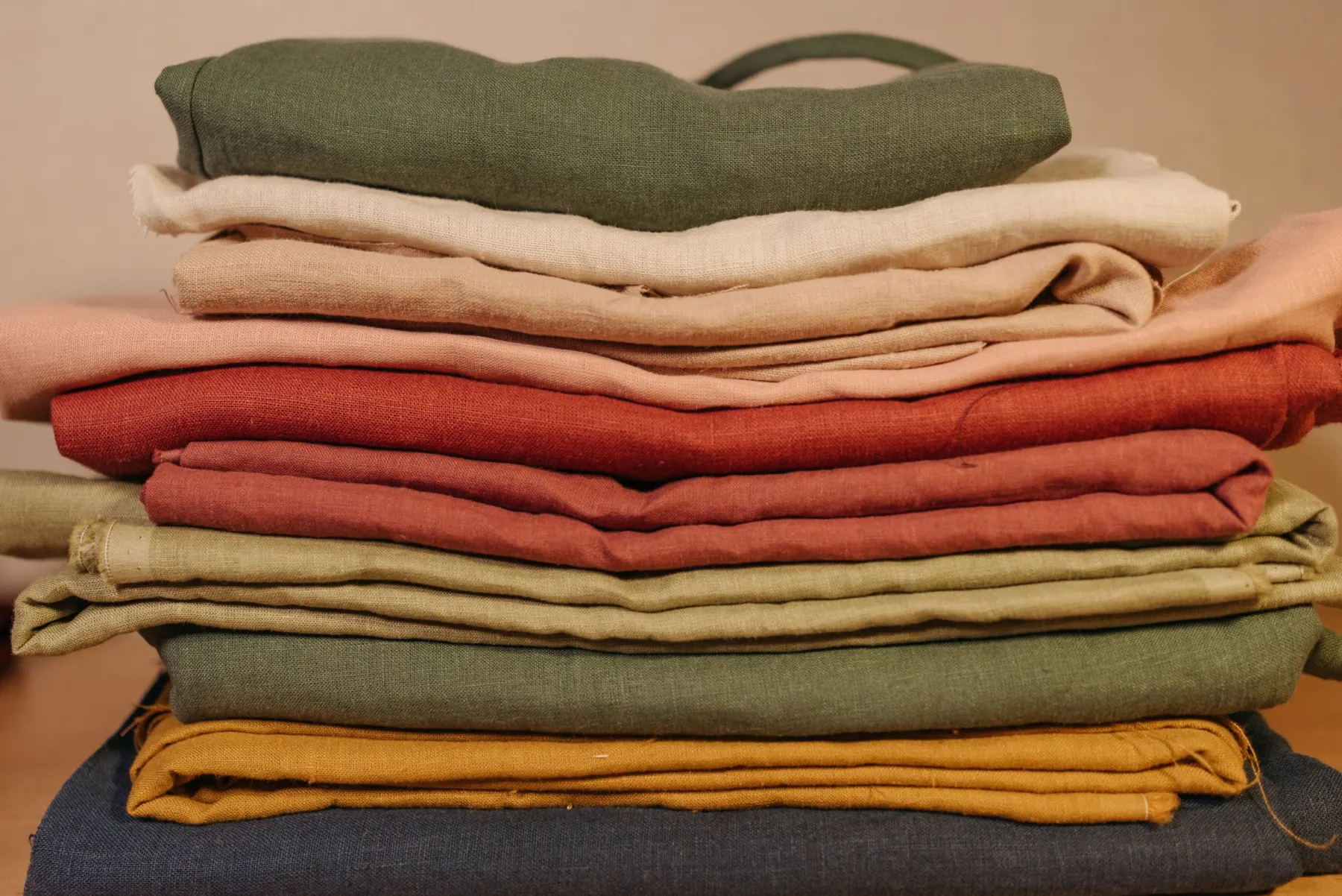
Try this before reading any further. Take three things from your wardrobe: a cotton shirt or T-shirt, something in linen, and something whose label says viscose (in the United States the same fibre is usually labelled rayon). Close your fist around a corner of each for ten seconds, let go, and look at what is left. Then hold each one by the shoulders and watch how it hangs.
What you see in those twenty seconds is most of what matters about these three fabrics in daily life: how readily they crease, how they fall, and how much attention they will ask for on laundry day. The rest of this piece explains why they behave as they do, and where the general picture stops being reliable.
Three fibres that start as plants
All three start as plants, which is why they have more in common with one another than with polyester or nylon. CottonWorks, the resource Cotton Incorporated publishes to promote cotton, describes cotton as cellulose-based because it comes from a plant, and rayon as cellulose-based too. The difference lies in which part of which plant is used and what has been done to it.
Cotton is, in CottonWorks’ words, a natural vegetable fibre obtained from the seed of the cotton plant. Linen is made from flax, and flax fibres are bast fibres: they are taken from the stem of the plant and not from its flowers, as the Alliance for European Flax-Linen & Hemp puts it. Viscose is the odd one out. It is a manufactured fibre: in the account given by CIRFS, the association of Europe’s man-made fibre producers, cellulose from wood pulp is chemically dissolved and then regenerated as fine filaments. That makes it neither a natural fibre in the way cotton is nor a synthetic in the way polyester, which is derived from fossil fuels, is. Viscose and rayon are two names for the same thing; labelling rules in the United States accept either.
What the touch test is showing you
The creases left in your fist are the visible sign of low elasticity. On the fibre summary used for the table below, cotton, linen and viscose are all rated poor for elasticity, where wool and polyester are rated excellent, so a fold that is pressed in tends to stay. What follows is our own description of how each usually behaves in the hand.
- Cotton usually shows soft creases and a matt surface. How it hangs depends enormously on the cloth: a poplin shirt stands away from the body, a jersey T-shirt drops.
- Linen gives the sharpest creases of the three and tends to feel cool and dry in the hand. It is not a fabric to choose if a pressed look that lasts all day matters to you; plenty of people like it precisely because the creasing reads as relaxed.
- Viscose is the one that pours. It is a familiar choice for fluid dresses and blouses because of the way it falls, CIRFS calls filament viscose an excellent material for linings, and it creases too, though the creases are often softer and hang out more readily on a fine cloth.
Those descriptions are tendencies, not guarantees. Weave, weight, yarn and finish change the result, and a fabric may have been treated to resist creasing. The fibre name tells you where to start, not where you will end up.
Side by side
The ratings below follow a fibre-properties summary published for Scotland’s Fashion and Textile Technology courses, which scores each fibre from poor to excellent; it lists viscose and rayon on separate rows, and the viscose row is used here. The first and last rows of the table are our additions.
| Property | Cotton | Linen | Viscose |
|---|---|---|---|
| Origin | Seed fibre of the cotton plant | Stem (bast) fibre of flax | Regenerated cellulose, mostly from wood pulp |
| Absorbency | Excellent | Excellent | Excellent |
| Breathability | Excellent | Excellent | Excellent |
| Strength | Excellent | Excellent | Fair |
| Durability | Good | Excellent | Fair |
| Crease resistance | Poor | Poor | Fair |
| Elasticity | Poor | Poor | Poor |
| Ease of care | Good | Fair | Fair |
| What that means when you wear it | Comfortable against the skin, creases, generally straightforward to wash | Cool and absorbent, creases sharply, wears for a long time | Soft and fluid, comfortable in warmth, needs the gentlest handling of the three when wet |
All three are rated excellent for absorbency and breathability, the qualities usually wanted in warm weather. The flax industry’s own body, the Alliance for European Flax-Linen & Hemp, cites a 2014 laboratory comparison carried out for it on linen, cotton, viscose and polyester samples, in which linen was the most permeable to water vapour and absorbed liquid fastest. Treat that as one study reported by an interested party.
Where each one can go wrong in the wash
Cotton
The hazard most often raised with cotton is shrinkage. CottonWorks, which speaks for the cotton industry, explains it as a relaxation effect: fabric is put under stress during wet processing and the yarns are bent into the structure, and once that stress is removed they tend to settle back. Knitted fabrics of every kind, it says, are inherently more prone to shrinkage than woven ones, which would make a jersey T-shirt more likely to change size than a woven shirt. GINETEX, the association behind the international care symbols, states that lower temperatures than the label shows are always permitted, so washing cooler and drying with less heat is a reasonable precaution for a piece whose fit you care about.
Linen
The Alliance’s care advice, which is again the industry’s own, is that linen can be machine washed on a delicate programme at 30 °C where the label agrees, and that it becomes softer and more flexible with washing. Its cautions concern handling: too much spinning can wrinkle the cloth and shorten its life, and excessive heat in a tumble dryer can alter the fabric and possibly cause shrinkage. It recommends drying in the air away from direct sun and ironing while the cloth is still slightly damp. On irons, GINETEX matches the cotton/linen setting to the hot-iron care symbol, which allows a sole plate of up to 210 °C, but only where the label shows it.
Viscose
Viscose needs the most care, for one specific reason: it is weaker wet than dry. The Museum of Design in Plastics at Arts University Bournemouth, in its curators’ guide to synthetic garments, records that viscose rayon loses about 50 per cent of its strength when wet and that dry cleaning is recommended. Labels vary all the same. GINETEX gives viscose and modal among its examples for the mild 30 and 40 °C machine cycles, with a reduced load and little or no spinning, so the label on the piece in front of you is the only guide to which treatment it can take.
Where the label shows the hand-wash symbol, GINETEX’s instructions are to dissolve a fine detergent in plenty of water, let the garment float and move it carefully, and not to rub, pull or wring it; then rinse well, press the water out carefully, pull the piece into shape and not leave it lying wet. Its moderate iron setting, the one that covers viscose, is used through a slightly damp cloth and without heavy pressure. Because the wet cloth is at its weakest, we would test anything, even water on a stain, on a hidden seam allowance first, and take a marked or valuable piece to a professional cleaner.
One related name is worth recognising. Modal, also called polynosic or high wet modulus rayon, is recorded in the same museum guide as the fibre that addressed the wet-strength problem. The composition label says which of the two you have, which is one more reason to read the care label properly before deciding how to wash something.
Choosing between them for a particular job
These are options, not rules, and they assume a plain fabric with no special finish.
- For something washed weekly such as shirts, T-shirts and everyday trousers, cotton is rated the easiest of the three to care for. If you are weighing up shirts specifically, the same reasoning runs through our guide to finding a white shirt that suits your routine.
- For heat, linen has the lowest warmth rating of the three on the same summary. Between linen and viscose the choice, as we see it, is between dry crispness with visible creases and softness with movement.
- For drape in a dress, wide trousers or a blouse, viscose is the one we would reach for, accepting more careful laundering as the price.
- For hard, long wear, linen is rated excellent for durability and cotton good.
Many garments sidestep the choice by mixing fibres: linen with viscose for a softer hand, cotton with a little elastane for stretch. What those percentages can and cannot tell you is covered in our piece on fabric blends. And if the fist test left you wondering how creased linen and smooth viscose sit next to each other in one outfit, that is a question of combining textures, which is a matter of taste and a pleasant one to experiment with.
Sources
- CottonWorks (Cotton Incorporated) Natural vs. Synthetic Fibers
- Alliance for European Flax-Linen & Hemp Everything you need to know about European flax
- CIRFS (association of European man-made fibre producers) CIRFS: Viscose
- US Federal Trade Commission Threading Your Way Through the Labeling Requirements Under the Textile and Wool Acts
- Qualifications Scotland (formerly SQA) Summary of fibre properties
- Alliance for European Flax-Linen & Hemp Flax fibre - Performance and properties
- Alliance for European Flax-Linen & Hemp Washing linen: Linen care tips
- CottonWorks (Cotton Incorporated) Shrinkage & Skewing
- Museum of Design in Plastics (Arts University Bournemouth) Viscose rayon
- GINETEX Care symbols
- GINETEX Care labelling