How to Combine Textures in a Simple Outfit
Sort your clothes by touch and by how they take the light, then put unlike surfaces side by side. A comparison of eleven everyday fabrics and three combinations.
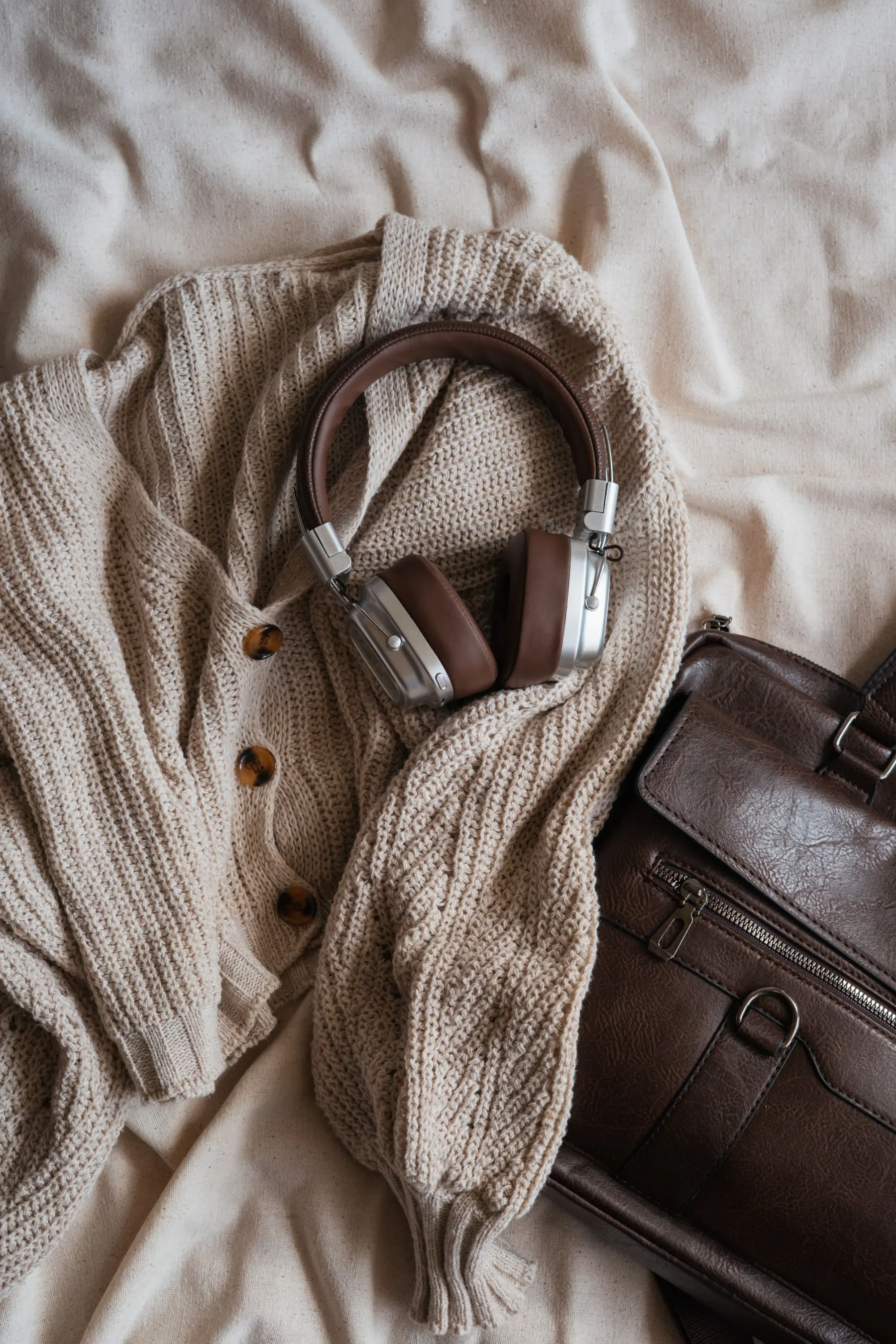
Close your eyes and run a hand slowly along the clothes on your rail. Within a few hangers you will have touched something smooth and cool, something soft and slightly fuzzy, something dry and crisp, perhaps something ribbed. You can tell them apart without seeing a single colour.
That is texture, and it is the part of an outfit people tend to leave to chance. Colour and shape get the attention; surface is whatever the garments happened to be made of. Yet when an outfit of perfectly good pieces looks flat, the reason is often that every surface in it is the same. This guide sorts everyday fabrics by how they feel and how they take the light, and then puts them together.
Two questions to ask of any fabric
Is it matt or does it shine? Hold the garment near a window and tilt it. Some surfaces soak up the light and look the same from every angle; others throw it back as a highlight that moves when the fabric moves.
Is it flat or raised? Stroke it. Some fabrics are level under the fingers. Others have ridges, loops, a brushed pile, a visible weave or a knit you can count the stitches of.
Those two answers place almost anything in your wardrobe. A third quality, how stiff or fluid the fabric is, affects how it hangs, and is worth noticing too.
Everyday surfaces compared
The descriptions below are of typical examples. Individual garments vary a great deal with weight and finish, so trust your own hand and eye over the table.
| Surface | Under the hand | In the light | Sits easily beside |
|---|---|---|---|
| Cotton poplin shirting | Smooth, cool, crisp | Matt with a slight sheen when pressed | Anything raised: knits, corduroy, tweed, denim |
| Cotton jersey (T-shirts) | Soft, flat, slightly stretchy | Matt | Crisp or structured layers: denim, twill, leather |
| Denim | Firm, dry, a fine diagonal ridge | Matt, uneven in colour | Smooth shirting, soft knits, leather |
| Chunky or ribbed knit | Soft, deep, clearly raised | Matt, with shadows between the stitches | Flat, smooth fabrics: poplin, satin, fine wool trousers |
| Fine-gauge knit | Soft, nearly flat | Matt to faintly lustrous | Rougher cloth: tweed, corduroy, denim |
| Wool flannel | Soft, slightly fuzzy, dense | Matt, blurs the colour a little | Crisp cotton, smooth leather, fine knits |
| Corduroy | Velvety ridges | Changes shade with the direction of the pile | Plain, flat fabrics above or below it |
| Linen | Dry, cool, slightly irregular | Matt, with creases that catch shadow | Smooth cotton, fine knits, suede |
| Satin or other lustrous weaves | Slippery, fluid | Clear moving highlights | Matt, dry or rough surfaces: knits, denim, flannel |
| Smooth leather | Firm, cool, even | Soft shine, more when polished | Matt wool, denim, cotton |
| Suede | Soft nap that marks when brushed | Matt, deep in colour | Smooth or crisp fabrics, lustrous ones |
The last column follows one idea: a surface shows up best next to something unlike it. Rough beside smooth, matt beside shine, crisp beside soft. If you want to know why cotton, linen and viscose feel as they do in the first place, understanding everyday fabrics goes into the fibres.
How much contrast: three working levels
One change. Most of the outfit shares a surface and one piece differs. A ribbed jumper with flat cotton trousers and plain leather shoes is the simplest case. This is enough for most days.
Three surfaces. One smooth, one raised and one with some shine, such as a poplin shirt, flannel trousers and polished leather shoes. Many long-established combinations turn out to be this when you look at them closely.
Same family throughout. All matt and soft, or all crisp and smooth. This can look deliberate and calm, particularly when the colours differ, but if colour is also held steady the outfit has nothing to separate its parts.
Which brings up the most practical use of texture. When an outfit is all one colour, or all dark, surface does the work that colour contrast would otherwise do. A black jumper, black trousers and black boots become three distinct things once the jumper is ribbed, the trousers are smooth wool and the boots are suede. The same applies to the single-family outfits in a simple guide to wearing tonal colours.
Three combinations to try
Rough over smooth
A raised, matt outer surface with something crisp and flat showing at the edges.
- Pieces
- A chunky cream or oatmeal jumper (sweater) over a pale blue poplin shirt with the collar and cuffs showing, dark denim jeans, brown suede boots.
- Swaps
- A corduroy overshirt in place of the jumper in milder weather. Wool trousers in place of denim for work. Smooth leather shoes if suede is impractical in rain.
- The detail
- The cuff. A centimetre or two of crisp shirt beyond the knitted sleeve puts the two textures directly next to each other.
One shine among matt
A single lustrous piece surrounded by dry, quiet surfaces, so the shine looks relaxed and not dressed up.
- Pieces
- A satin skirt or a satin-finish shirt, a grey fine-gauge knit or plain cotton T-shirt, a wool blazer or denim jacket, matt leather trainers (sneakers) or loafers.
- Swaps
- For a menswear version, a silk or satin tie or a polished leather belt as the one shiny element with a flannel suit or wool trousers and a knit. For evening, change the trainers for a polished shoe and let there be two points of shine.
- The detail
- Jewellery and hardware count as shine too. With a lustrous garment, a plain watch or small earrings keeps the highlight in one place.
All black, three surfaces
One colour from neck to toe, separated only by how each piece takes the light.
- Pieces
- A black ribbed roll-neck, black smooth wool or cotton-twill trousers, a black leather jacket or a black brushed-wool coat, black suede or matt leather boots.
- Swaps
- Navy, grey or brown throughout works the same way. In warm weather: a black linen shirt, black cotton trousers and black leather sandals.
- The detail
- Black garments rarely match, and beside each other a faded one can look tired. Different textures make the difference in shade look intended.
Where it tends to go wrong
Everything raised. A cable-knit jumper, corduroy trousers and a tweed jacket are each appealing, and together they can look heavy, with no resting place for the eye. Changing one for a flat fabric, a plain shirt showing at the neck for example, is usually enough.
Everything smooth and thin. A jersey top with thin smooth trousers and a thin smooth jacket can look like one piece of cloth. Adding weight somewhere, such as a heavier knit or a firmer shoe, gives the outfit a centre.
Worn texture read as chosen texture. Pilling, a flattened pile or a shiny seat on wool trousers are also surfaces, and the eye picks them up. Raised fabrics need a little upkeep to stay looking the way they were made; knitwear care covers washing, drying and storing knits.
A two-minute habit
Before leaving the house, touch each visible piece in turn, top to bottom, and name its surface in a word: fuzzy, crisp, smooth, ridged. If you say the same word every time and the outfit looks dull to you, change the piece that is easiest to change. Often that is the shoes or the layer nearest the neck.