A Simple Guide to Wearing Tonal Colours
One colour family in several depths: a ten-minute method for finding tonal outfits in your own wardrobe, then four worked examples in blue, green, red-brown and grey.
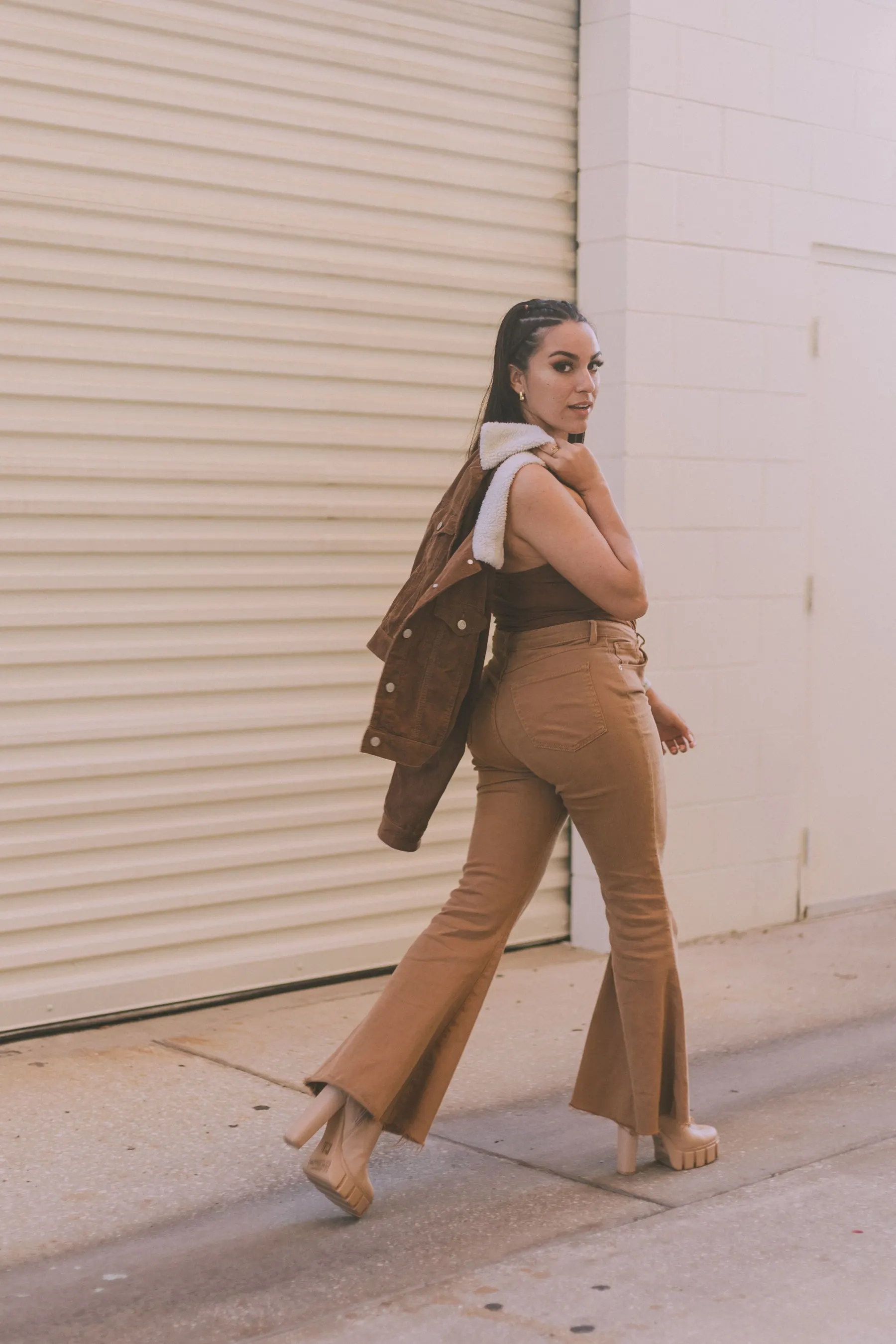
In this guide, a tonal outfit means one built from a single colour family worn in several depths: pale blue with mid-blue and navy, or sand with tan and chocolate. Nothing has to match. You may see the same idea called monochrome or head-to-toe colour; we use “tonal” because the shades are related rather than identical, and the differences between them are the point.
It is one of the more forgiving ways to wear colour, because every piece already has something in common with the next. It also uses clothes you own. Many wardrobes turn out to contain three or four things in one family without their owner having planned it.
A short method: lay out, sort, choose
This takes about ten minutes and is easier on a bed in daylight than in front of a mirror.
- Pick the family you own most of. Blue is often the answer because of denim, but it may be green, brown, grey or red. Pull out everything in that family, including shoes, scarves and bags.
- Line the pieces up from lightest to darkest. You are looking for at least three clear steps. Two pieces very close in depth can look like a failed attempt at matching; a visible gap between them looks intended.
- Check the temperature. Some blues lean towards green, others towards purple; some browns are reddish, others yellowish. Pieces that lean the same way sit together easily. A piece that leans the other way is not unusable, but it tends to work better as a small accent than as half the outfit.
- Decide where the darkest piece goes. Darkest at the bottom feels grounded and familiar. Darkest on top, with paler trousers, is less expected and draws the eye upwards. Darkest as the outer layer frames everything inside it.
- Add one change of surface. When colour is held steady, texture does the work that contrast normally does. A matt knit beside smooth cotton, or suede beside denim, keeps a one-colour outfit from looking flat. There is more on this in how to combine textures in a simple outfit.
Four families worked through
Blue: chambray, indigo and navy
The easiest place to start, since two of the three pieces are likely to be denim or close to it. Three depths of blue, three different fabrics.
- Pieces
- A pale chambray or light-blue cotton shirt, dark indigo straight-leg jeans, a navy wool jumper (sweater) or navy overshirt as the top layer, white or navy trainers (sneakers).
- Swaps
- A sky-blue T-shirt in summer with the jumper left at home. Navy tailored trousers in place of jeans for work. A cobalt scarf if the three blues feel too quiet.
- The detail
- The gap between shirt and jeans. If the denim and the shirt are nearly the same blue the outfit turns into a matching set; a clearly paler shirt keeps them distinct.
Green: sage, olive and forest
Greens vary a great deal in temperature, so this family rewards the lining-up step. Sage and olive both lean grey-yellow and sit together calmly; a deep forest green anchors them.
- Pieces
- A sage-green T-shirt or fine knit, olive cotton trousers or a utility-style skirt, a forest-green corduroy overshirt or quilted jacket, brown leather boots.
- Swaps
- Khaki shorts in hot weather. A dark green wool coat in winter over the same two inner layers. A cream T-shirt in place of the sage one if you only own two greens.
- The detail
- The shoes. Brown leather keeps the outfit earthy and continuous; white trainers interrupt it and make it look sportier.
Red and brown: rust, burgundy and chocolate
This is tonal dressing at its warmest, and it shows that the idea is not limited to neutrals. The three shades share a red-brown base, so a strong colour can be worn head to toe without shouting.
- Pieces
- A rust or terracotta knit, burgundy trousers or a burgundy midi skirt, a chocolate-brown wool coat or suede jacket, dark brown shoes.
- Swaps
- A blush-pink shirt as the lightest step in spring. Dark brown jeans or cords in place of burgundy for a quieter lower half. A burgundy scarf alone, over brown and rust, if burgundy trousers are a step too far.
- The detail
- Metal. Gold-coloured jewellery, buckles or buttons look warm against these shades; silver looks cooler and crisper. Either is fine, but mixing both can muddle a carefully narrow palette.
Grey: pale marl to charcoal
Grey has no hue to speak of, so the whole effect rests on depth and texture. It is the family most likely to look dull if every piece is smooth, and most interesting when the surfaces differ.
- Pieces
- A pale grey marl sweatshirt or brushed-wool jumper, mid-grey flannel trousers, a charcoal overcoat or blazer, black or grey shoes.
- Swaps
- A white T-shirt as the lightest step. Grey jeans at the weekend. A single coloured accent such as a red beanie, a yellow sock or a green bag, which a grey outfit carries very clearly.
- The detail
- Marl and fleck. A grey made of mixed light and dark threads has more life than a flat one, and one flecked piece is often enough.
What usually goes wrong, and the fix
Near-misses. Two pieces intended to be the same colour that turn out slightly different under daylight are the commonest disappointment, especially with black and navy. The fix is to stop trying to match and separate them by at least one clear step, or to put a third shade between them.
Everything the same weight. A thin top, thin trousers and a thin jacket in one colour can look like a uniform. Changing the weight of one layer, with a heavier knit or a stiffer jacket, gives the outfit a top and a bottom again.
No break at all. A full column of one family is striking. If it feels like too much, the neck, the wrist and the ankle are where a break is least disruptive: a white T-shirt edge, a watch strap, a pale sock.
If you own only two pieces in a family
Two shades of one colour with a neutral in between already reads as tonal. Navy trousers and a pale blue shirt with a grey jumper, or an olive jacket and a sage top with cream trousers, give most of the effect. A blazer makes a handy third element here, and several combinations in one blazer, five everyday outfits can be shifted towards tonal by changing only the knit.
From there the palette can grow slowly, or not at all. If your wardrobe is mostly black, grey and beige and you would like to move one step towards colour, tonal dressing is a gentle route: start with the family nearest to what you already wear, and let the deepest shade stand in for the black you would otherwise reach for. Other small steps of the same kind are set out in adding colour to a mostly neutral wardrobe.