Borrowing an Idea from a Trend Without Rebuilding Your Wardrobe
Name the idea underneath the thing you keep seeing, find it in clothes you own, and wear the smallest version three times. A worked, invented example.

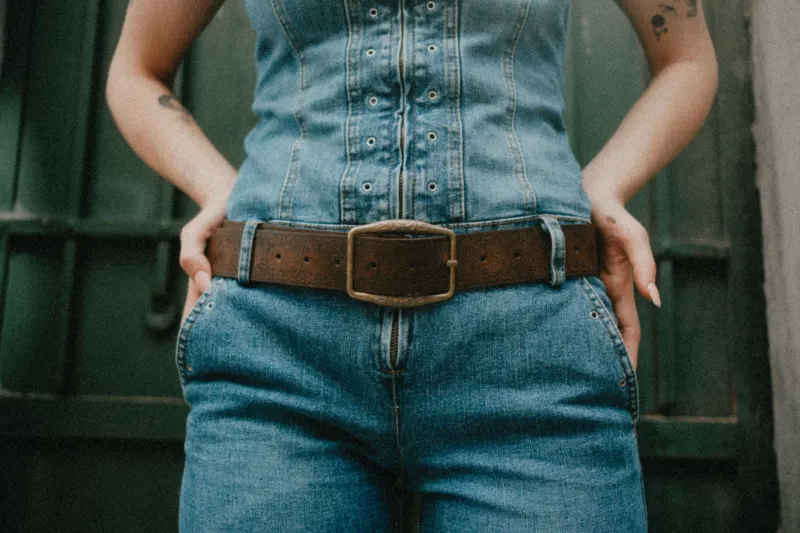
Suppose that one year wide belts are suddenly everywhere. They are in shop windows, on people you pass in the street and in every second picture on your phone, usually worn over a jacket or a coat. Suppose, too, that you rather like the look. This is an invented example; MEDUZA does not cover trends, and the belt could just as well be a colour, a trouser shape or a kind of collar.
There are two familiar responses. One is to buy the belt and whatever seems to be worn with it. The other is to ignore the whole thing on principle. This piece works through a third: find the idea underneath, look for it in the clothes you own, and try the smallest version first.
Step one: name what you actually like
A trend arrives as an object, but what catches the eye is usually an idea the object carries. Nearly always the idea is one of four things.
- A colour, or a pairing of colours.
- A proportion: where something sits, how long or wide it is, where the outfit divides.
- A texture: shine, roughness, softness, sheerness.
- A detail: a particular collar, a visible sock, a rolled hem, a fastening.
Look at three or four pictures of the thing you like and ask what they share apart from the object itself. With the imaginary wide belt, the belts may differ in colour and material from picture to picture while every one of them does the same job: it draws a firm horizontal line across a loose outer layer and gathers the fabric there. If so, the idea is a proportion, “a defined line at the middle of a roomy shape”, and the belt is only one way of drawing it.
It might be something else. If every belt you were drawn to was tan against a dark coat, the idea may be a colour contrast. If they were all glossy leather over matt wool, it may be texture. Being honest at this stage saves effort later, because each answer sends you to a different part of the wardrobe.
Step two: look for the idea in what you own
Now search your wardrobe for the idea, not the object. For “a defined line at the middle of a roomy shape”, the candidates in an ordinary wardrobe might be:
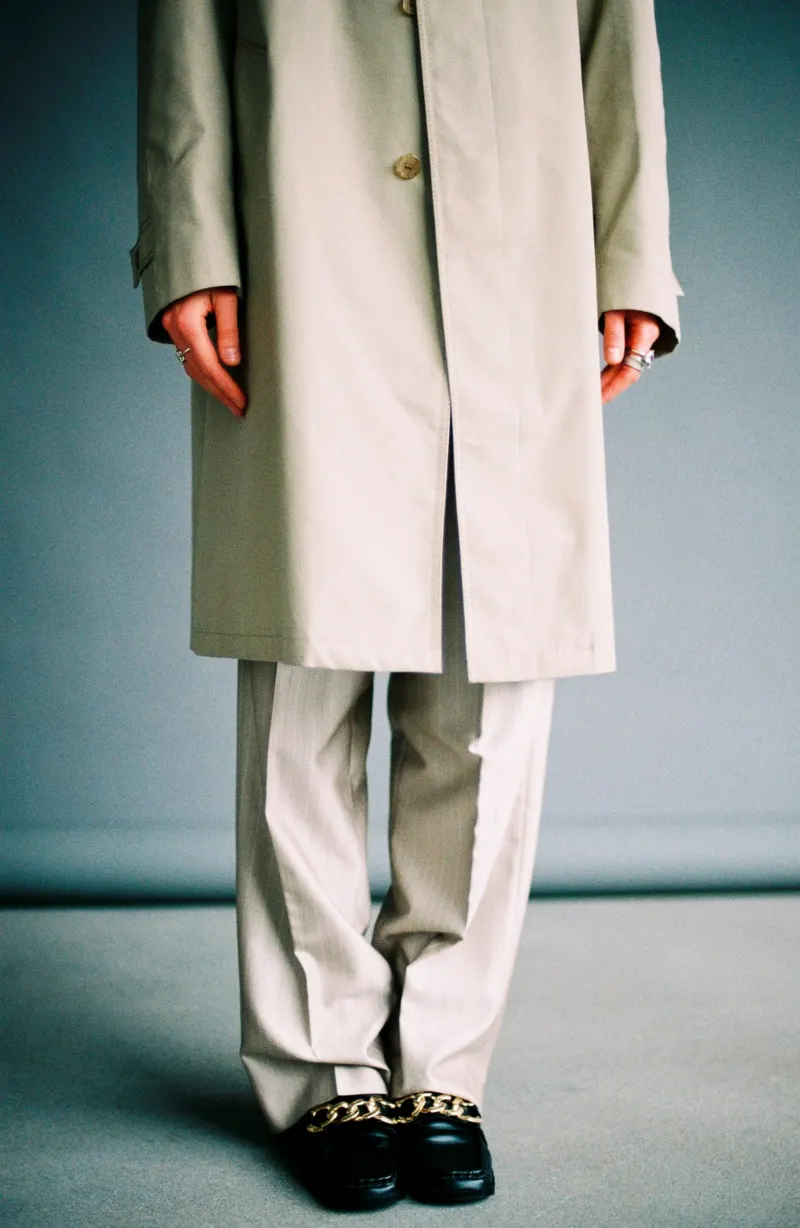
- the fabric belt that belongs to a trench coat or dressing-gown-style coat, tied instead of left hanging;
- an ordinary trouser belt worn over a long cardigan or an overshirt;
- a shirt tucked into high-waisted trousers under an open coat, so the waistband supplies the line;
- a cropped jacket over a longer, looser layer, which draws the line with its hem;
- a long scarf wrapped once around the middle of a coat and knotted.
None of these is a wide belt. All of them test whether you like the idea on yourself, in your own clothes, on an ordinary day. For more on what a line at the middle does to the blocks of an outfit, see how belts change the proportions of an outfit and the broader explanation in understanding proportion.
Step three: wear the smallest version three times
Choose the candidate that needs the least courage and wear it on three normal days, not for an occasion. Three is an arbitrary number, but one wear tells you only whether the novelty is pleasant; by the third you know whether you adjust it all day, whether it works sitting down and under a bag strap, and whether you would reach for it without thinking.
The idea, in the smallest version
A firm line at the middle of a loose layer, using only things already in the wardrobe.
- Pieces
- A long navy or grey cardigan worn closed, an ordinary brown leather trouser belt fastened over it, straight-leg jeans or trousers, a plain T-shirt or shirt underneath, ankle boots or loafers.
- Swaps
- A trench coat with its own belt tied at the front. An overshirt belted over a roll-neck. For a quieter test, skip the belt and wear the shirt tucked under an open cardigan so that only the waistband draws the line.
- The detail
- Whether the belt is close in colour to the layer or contrasts with it. Close in colour gathers the fabric without drawing much attention; a contrast makes the line the first thing seen.
Photograph each of the three wears. The pictures are for you alone, and they make the next step much easier.
Step four: read the result
After three wears there are three possible conclusions, and each is a good outcome.
You liked it and the substitute is enough. The belted cardigan has become something you wear. The idea is now part of how you dress, and nothing further is needed.
You liked it, and the substitute falls short in a way you can describe. Perhaps the narrow belt twists, or disappears against a bulky coat. Now, and only now, a wider belt is a defined gap and not an impulse. You know what it would be worn over, which colour your test suggested and what width the narrow one lacked. That is the kind of specific need described in how to identify the gaps in your wardrobe before shopping, and a description that precise is what makes it possible to shop second-hand with a clear plan.
You did not like it. You admired the look on others and felt trussed up in it yourself. That costs nothing and settles the matter. You can go on enjoying it on other people.
The same method on a different idea
To show that the steps do not depend on belts, run them on a second invented case. Suppose that chocolate brown starts appearing where black would normally be: coats, boots, knitwear.
Name the idea: it is a colour, and more precisely “a dark, warm neutral in the place of black”. Look for it: most wardrobes have brown somewhere, in a belt, a pair of shoes, a bag or an old cord jacket. Try the smallest version: take an outfit you would normally finish with black shoes and a black belt and use the brown ones, or wear a brown jumper with the grey trousers you always pair with black. Three wears, three photographs, then decide.
Ideas of this kind are seldom as new as they look. A belted coat, brown where black might be, a wider or narrower trouser leg, a higher or lower waistband: these are variations on things ordinary clothes already do, which is one reason so many wardrobes contain the means to try them.
When to let one pass
Some ideas do not shrink. If the whole point is a garment unlike anything you own, there may be no small version, and it is reasonable to admire it and move on. The question that sorts these cases is simple: once the excitement of newness is removed, is there anything left that you can name? If the answer is “the colour” or “the length”, there is something to borrow. If the answer is only “everyone has one”, there is not.