What to Check When Trying On Everyday Shoes
A fitting-room sequence drawn from podiatry and health-service guidance: when to go, what to wear, and how to check length, width, depth and heel.
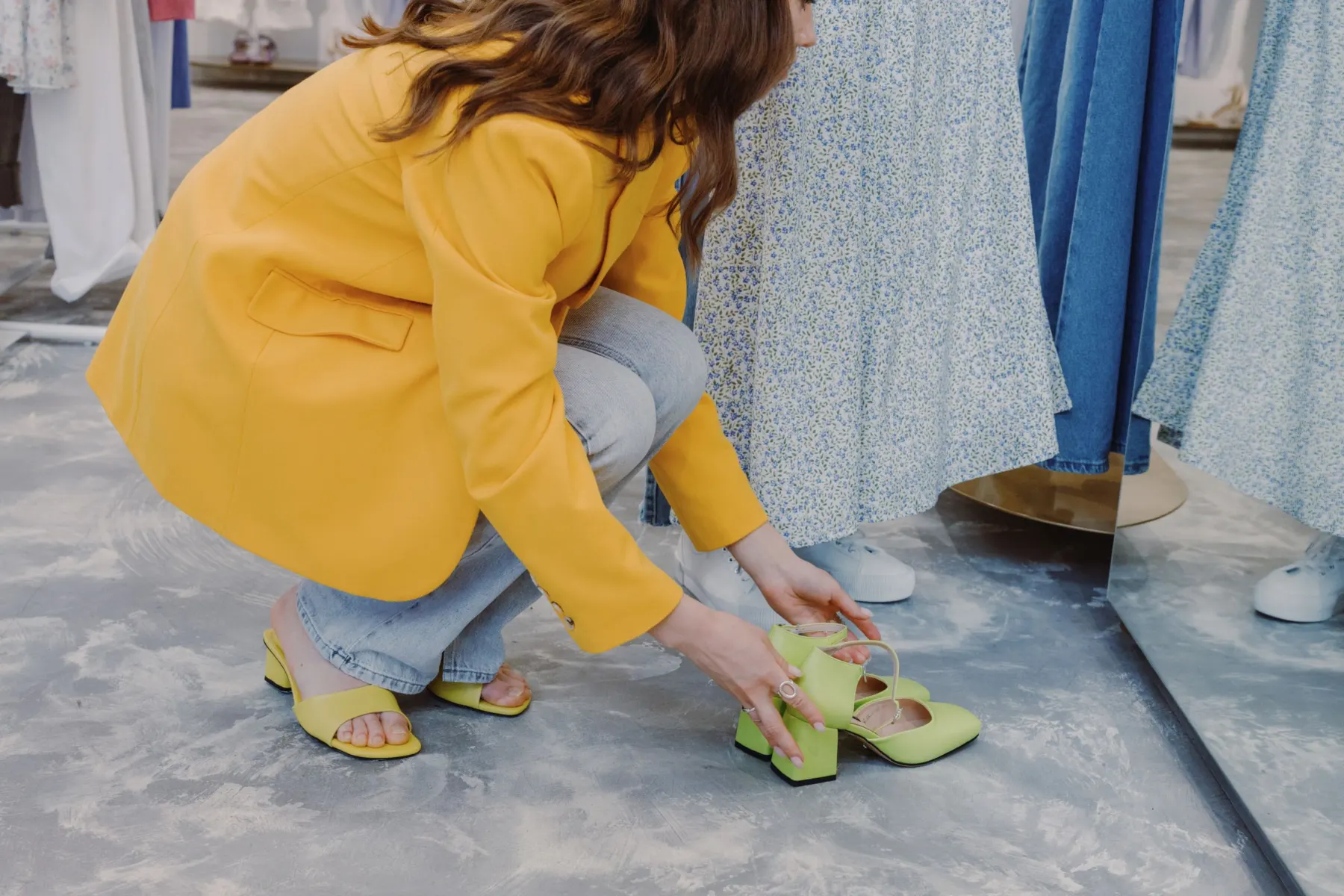
Most shoes that turn out to be wrong felt acceptable for the ninety seconds they were tried on. The fitting was too short, done sitting down, at the wrong time of day, in the wrong socks, on one foot. Podiatry bodies and health services publish very similar advice on how to avoid this, and it fits into a simple sequence that takes about ten minutes in a shop, or in your hallway with a pair that has arrived by post.
What follows is general fitting guidance for everyday shoes, gathered from those published sources. It is not medical advice.
Before you go: time of day, socks and what is already in your shoes
Go later in the day. The Royal College of Podiatry advises buying footwear in the afternoon, when feet are at their largest. NHS footwear guidance and the American Academy of Orthopaedic Surgeons say the same, the latter giving the reason that feet may swell through the day. A pair tried on first thing may feel tighter by the evening.
Wear the socks you will wear with the shoes. NHS advice from Bradford District Care Trust is to try shoes on in the socks you will actually use, and the orthopaedic surgeons’ guidance likewise says to use the same sock thickness. Thick walking socks and fine dress socks can differ by enough to change the fit. Take tights, or go bare-legged, if that is how the shoes will be worn.
Bring your insoles. If you use your own insoles or orthotics, they need to go into the shoe during the fitting. The Royal College of Podiatry suggests checking whether the footbed is removable, since that is what allows your own to be fitted in its place.
Step one: measure, both feet, standing
If you have not been measured for some years, start there. NHS Lanarkshire notes that feet change shape over time and can increase in length and width, so it is useful to have them measured when buying new shoes. The American Academy of Orthopaedic Surgeons adds that you should stand while being measured, and the Royal College of Podiatry’s leaflet gives the reason: foot shape changes when you stand.
Measure both. Most people’s feet are slightly different sizes, according to the NHS guidance, and the consistent advice is to fit the larger foot. The American Academy of Orthopaedic Surgeons also warns against relying on the number alone. Sizes vary between makers and styles, so the size on the box is where the trying-on starts, not where it ends.
At home, NHS Borders describes a quick check that needs no equipment: take the insole out of the shoe and stand on it. It should be as wide as your foot, with about a thumb’s width beyond your longest toe.
Step two: put both shoes on and stand up
Fasten both shoes properly, as you would for a day’s wear, and stand. Then work through three dimensions; the Royal College of Podiatry says length, width and depth all need considering.
Length. There should be a gap between the end of your longest toe and the end of the shoe. The Royal College of Podiatry puts it at around 1 to 1.5 cm, roughly the width of your thumb; the American Academy of Orthopaedic Surgeons says half an inch, which is much the same. Note longest toe: it is not the big toe on everyone. Harvard Health suggests standing in the shoes and pressing gently on the top of the shoe to feel where your toes end.
Width. The shoe should be wide enough for the broadest part of your foot. Look down at the shoe as well as feeling it: NHS Borders points out that if your foot is pushing the shoe out of its own shape, the shoe may be pressing on the toe joints. Harvard Health’s fitting advice is that a wider fitting is the answer here, since going up half a size adds length without necessarily adding the width you need.
Depth. The front of the shoe needs to be deep enough for your toes as well as long enough. You should be able to move them freely; if the upper presses down on the toes or nails, a different shape of toe will serve you better than a different size.
Step three: check the heel and the fastening
The heel of the shoe should sit snugly round your own. NHS Lanarkshire describes a heel that fits closely enough to steady the foot. The orthopaedic surgeons’ guidance warns that if the vamp, the part of the upper over the middle of the foot, is too loose, the heel may slip out of the shoe.
A fastening makes a difference. The Royal College of Podiatry recommends some way of adjusting the shoe across the top of the foot, whether laces, a strap or a touch-fastening, because it helps the shoe stay on and gives a closer fit. NHS Borders notes that slip-on shoes rely on the toes gripping to keep them on, which is a reason to try a loafer or ballet flat with particular care: there is nothing to adjust afterwards.
Step four: walk, on something hard
Walk for longer than feels polite. Harvard Health advises walking in the shoes to check that there is room across the ball of the foot and that the heel neither pinches nor slips, and trying them on hard floor as well as carpet to compare how they feel.
Pay attention to the first five minutes. NHS Lanarkshire and the Bradford trust both say that a correctly fitting shoe will feel comfortable from the start and, in the main, should not need breaking in. Pressure on a toe joint or rubbing at the heel in the shop is a reason to try another size, width or style, not something to wait out.
While the shoes are off, put a hand inside. Harvard Health suggests feeling for seams, tags or rough edges that might rub.
Looking at the shoe itself
Fit comes first, but a few features of the shoe are worth a glance while it is in your hand. The Royal College of Podiatry suggests checking that the sole offers enough shock absorption for the walking or standing you will do, and that the shoe bends at the front, where your toes bend, more than in the middle under the arch.
The college also suggests varying your heel height and keeping high heels for special occasions, and thinking about what you will be doing in the shoes: a shoe for standing all day has a different job from one for a dinner.
Price is not a guide to any of this. NHS Lanarkshire says plainly that an expensive shoe is not necessarily a better-fitting one, and the same is true of clothes: our guide to what to check when trying on a blazer works in the same way, through a sequence of checks made with the garment on.
After you get them home
Wear new shoes indoors on a clean floor for an hour or two before committing to them. NHS Borders advises wearing new shoes in gradually even when they felt comfortable at the fitting. If they arrived by post, this indoor trial is your fitting room, so run through the same sequence, in the afternoon, before deciding whether to keep them.
Once they have passed, two things remain. One is how they meet your trousers, which our guide to matching shoes to trouser shapes covers. The other is looking after them. The Royal College of Podiatry’s foot-care tips include trying not to wear the same shoes two days in a row, and the routine for each material is set out in our care basics for leather, suede and textile shoes.
Sources
- Royal College of Podiatry (leaflet hosted by Harrogate and District NHS Foundation Trust) Choosing the right shoes for you
- NHS Lanarkshire Footwear advice
- Bradford District Care NHS Foundation Trust Footwear advice
- NHS Borders (Right Decision Service, Healthcare Improvement Scotland) Guide to buying footwear - information for patients
- American Academy of Orthopaedic Surgeons (OrthoInfo) Shoes: Finding the Right Fit
- Harvard Health Publishing (Harvard Medical School) 10 tips for finding the right shoes